

| Wearable Technologies In this article, three senior citizens who each wear a different wearable technology write from their personal experience. We feature three such technologies: the Oura Ring, the Apple Watch, and the Fit Bit. Each one helps their wearers be more healthy and safe. |
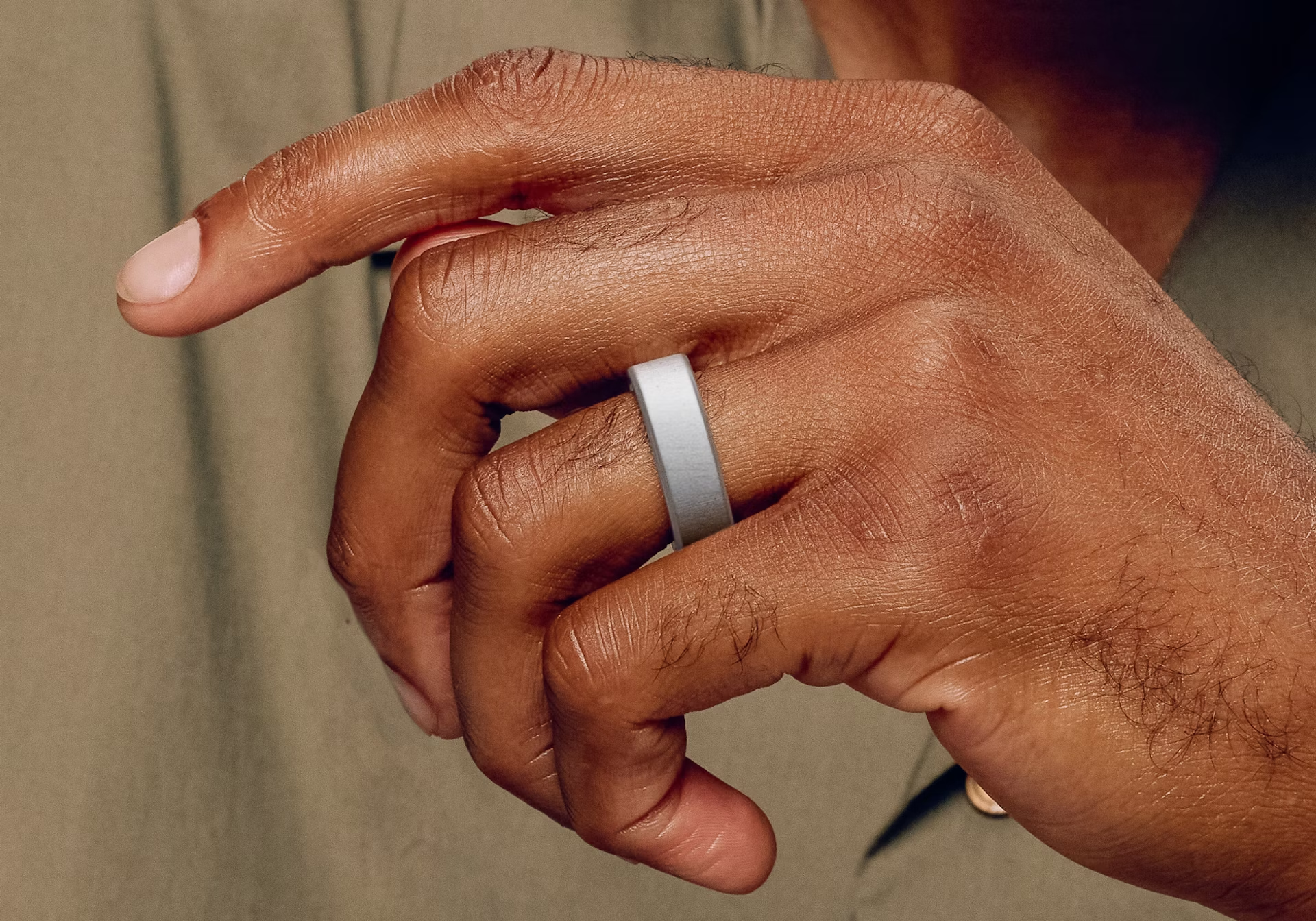
| The Oura Ring Wendy C. Kasten My husband and I enjoy watching classes on varied topics from The Great Courses program. We recently viewed “The Scientific Guide to Health and Happiness.” The professor/lecturer was Dr. Robin Miller, a physician of integrated medicine from the northwest. She mentioned the Oura ring she was wearing. I was intrigued with what she said about the ring, so I was delighted that my husband gave me one for my birthday. I was immediately drawn to the value of understanding my sleep issues and monitoring my pulse and breathing (I have asthma). Since a first-degree relative, close in age, had three cardiac medical events, I was further motivated to monitor the data the Oura ring provided. An Oura ring (ouraring.com) is available in multiple finishes and is worn around the clock, even when swimming and showering. It collects vital signs and transmits them to an APP on your smartphone. It looks like a slightly bulky man’s ring and can be worn on any finger. When you place a preliminary order, Oura sends a kit of plastic rings identical in size and shape to an actual ring to try out sizes on different fingers to decide what will be most comfortable. Oura encourages the potential buyer to wear the plastic rings on different fingers for at least 24 hours before completing the purchase. When you begin wearing Oura, it “gets to know” you and monitors body temperature, breathing, pulse, activity, and sleep. The company may offer updates to include additional functions. The ring provides a graph of sleep, separating light sleep, from deep sleep, and REM sleep. It recommends the time to go to bed and when it’s best to take it easy for the day. And it warns you if you’re coming down with something, recommending you rest and take it easy. The prices are currently between $275. -$575.00 depending on the finish the buyer selects (gold is the highest priced). Following that time period, there is a monthly charge of approximately $5.00 per month. The Oura ring needs to be charged approximately every 3 days. The charger is included and is easy to use. Customer support is text-based only; the company is located in Finland. So far, I have learned I have been staying up too late, that my activity is on the light side, and that my heart takes most of the night to get to a “resting heart rate.” I plan to discuss this and other data with my primary care physician. The Oura ring might be a tool for someone with irregular heart rhythms or someone with sleep issues. Those are issues to discuss with the company. Lastly, I enjoy the embedded library of recordings to help relax and fall asleep. Oura rings are sold online and at Best Buy(ouraraing.com). More recently, new features have been added. Oura now gives you oxygen sensing, and VO2MAX (a measure of overall cardiovascular health). It also sends you a warning if something is “straining your body” which usually means you are about to become ill. In these instances, I cancel all plans and got to bed to try and avert something serious. I believe this smart tool can be helpful in understanding many aspects related to living a healthy life. |
Apple Watch by Martha Stamp I am over 70 and live alone. My sister is five years younger, also living alone and a techie. Six years ago she purchased one of the early Apple Watches. She considered it better than other alert devises for elderly people because it is worn on the wrist and can activate a 911 call vocally. A sudden movement will automatically activate it unless the wearer stops it. The Apple Watch can also be connected to the wearer’s cell phone. This is helpful for me as I often walk alone on the beach and could quickly access help if needed. It also has a nice feature of locating your phone if it is misplaced. I have always worn a watch so it was natural for me to try an Apple Watch. It is a bit larger than the watch I usually wear, and there are a variety of bands from which to select. The Apple Watch holds a charge for a day and comes with a charger. The watch serves more purposes than only as a safety device. There are different apps you can have on it. For example, I use the exercise app that monitors my steps and offers incentives. I also access the weather. Because it is linked with my Apple Phone, I can talk on it (Think Dick Tracy!) and am notified when I receive a text. There are other apps offering health options, but I haven’t explored all of them. It is like wearing an Apple Phone on your wrist. An Apple Watch can be purchased through many carriers, such as US Cellular and Verizon. These watches can also be purchased through Amazon, Walmart, and Best Buy. The prices vary from approximately $152 for a refurbished one to $746 for the newest models. Not all will connect with the your specific carrier, so be careful to check the specs. I strongly recommend checking with your carrier first to see if they offer that service. I have found that feature to be invaluable when traveling. I love my watch and don’t know how I got along without it! |

| Fitbit Motivation by Joyce Ray We all know we need to keep moving to stay healthy, but sometimes I lack motivation to get out and walk. I know vaguely how far it is down to the pond and back, and some days I manage to make the circuit and pat myself on the back. But not often enough, until I bought my Fitbit. This little wristband device provides the motivation I need to get moving! I bought the basic Inspire Fitbit, no bells and whistles, three years ago, and it’s still going strong. It tracks my steps, my heart rate, calories burned, distance walked, and how many minutes of activity I log each day. It also tracks my hours of sleep, recording light, deep, and REM sleep. This is all I need, but I could log in my water intake and even the food I consume. It’s shower and swim proof, but I haven’t tested it. My Fitbit vibrates and launches firework graphics when I attain the step goal I set. For me, it’s very satisfying to reach my goal, knowing that I’m doing my best to stay healthy and fit. My winter goal was 5,000 steps (about two miles), but now that the weather is warmer, I’m increasing my goal by small increments. Most days, I check my step status an hour before bedtime, and if I’m lacking several hundred steps, I go for it- up and down stairs, in and out of rooms! The steps are logged, and I can check my weekly or monthly averages on my smartphone to see how diligent I’ve been. I can honestly say that I am more active with the Fitbit than without it. The device tells me the time and the date, so I could give up my wristwatch, but I haven’t. If I turn on Alerts, Bluetooth syncs it with my smartphone. The Fitbit can remind me of appointments, calls, texts, and probably lots of other things. However, I have definite opinions about being too tied to devices! The Fitbit Inspire sells for about $100 from fitbit.com, but there are 20% off spring sales, and competitive pricing may be found at a local Walmart, Best Buy, etc. My battery needs charging about every five days, but the new Inspire 2 advertises a 10-day battery life. A charger cord is included with purchase. Wristband color choices are black or white for the basic price, but other colors are available at additional cost. There is no maintenance fee. A one-year free Premium trial comes with purchase of a new Fitbit Inspire 2. Premium gives you personalized insights about your activity, all level workouts and step-by-step programs. This free offer was not available to me, and I have not subscribed to it. I’m satisfied with the information I receive. I recommend a Fitbit to anyone who needs motivation to get moving to maintain health. |

 Dr. Wendy C. Kasten, Writer