
Senior College, Senior College Class

Online Dating for Mature Beginners

Wendy C. Kasten, Ph.D. Copyright 2025

Online Dating for Mature Beginners (age 50+)

I met my husband from an online dating site. I was 61 and he was 60. Our first

date was actually at a dog park. We both had dogs, and this way we could see if

the dogs got along. I paid special attention to how he treated his dog.

Our lives together have been full of love, friendship, and growing closer together.

BUT, before I met my husband, I had tried about 15 dating sites (I lost count,

really), had about 50 first dates (conservative underestimate). Along the way, I

made some terrific male friends who I never “dated.” Even found a fabulous

accountant. And some of those friendships persist today. So, you can find

different things along the way before you find that special someone. Here are

things I learned which I would encourage anyone to heed.

Know what you are looking for.

Do you seek friends? A life partner? A

Marriage? One phrase you come across in the online dating world is “open to

possibilities.” I like the flexibility of that idea, as long as you are sincere.

Be clear about what you don’t want. If your partner must be a non-smoker,

of a certain age range, must love pets, etc., say that up front in your profile.

Constructing your profile is important.

For example, one mature friend one friend

decided she would no longer date anyone still raising children. After all, she’d

done that already and was in a different phase of her life. Here are some

things she listed: Must love pets; must be mentally and emotionally healthy;

non-smoker, at least a Master’s degree in educational level; over 5’10’ (men

generally exaggerate their height); have a valid passport. (my reason for the

latter is, if anyone gets to be 60 and never had a passport, then they probably

don’t have much sense of adventure, trying new things, etc.)

Explore a variety of sites. Google dating sites. You will get plenty of hits.

Some cost money, so decide if that’s okay with you. There are good ones that

do not cost anything. I met my husband on “okcupid.com.” It’s free, or was when I used it.

It asks lots

and lots of questions of each person joining. Therefore, you can get to know

lots about someone before deciding they are a potential partner for you. I also

appreciated plentyoffish.com, also free, as they hold local real events and you

can go to a dance where you know everyone there is single. There are sites

specific to the younger, to the older, to the very religious, to people of

particular interests.

Nearly all sites I explored account for same sex dating as well as heterosexual dating. Some sites allow salacious and nude photos.

Decide if that’s for you, or not (caution – in these sites, men often send

pictures of their equipment and not their face).

Some sites have different

“communities” within the site depending on what you are looking for, such as

“dating only,” “relationships only,” or “seeking sex partners only.”

CAUTION:

DON’T SIGN ON TO A SITE WITH AUTOMATIC BILLING UNLESS YOU KNOW

HOW YOU CAN QUIT. WHEN YOU WANT TO QUIT, PRINT AND SAVE THE

EMAIL WHERE YOU STATED YOU WERE QUITTING. BE VIGILANT CHECKING

THE CREDIT CARD YOU USED. YOU MAY NEED IT LATER TO DISPUTE

CHARGES ON YOUR CREDIT CARD. ONE SITE A FRIEND USED REQUIRED

ONE TO QUIT ONLY VIA A CERTIFIED SNAIL MAIL LETTER SENT TO A

FOREIGN ADDRESS!

Construct a good profile.

Use your best writing skills. Say who you are, and

what matters to you. Often you can read profiles before you join and get ideas.

A profile should state things about you, and things you want and do not want.

BEWARE of the profile that is all about what someone is looking for, and

nothing about who THEY are. Here is an example of a good

profile:

SUCCESSFUL PROFESSIONAL SEEKS A PARTNER POSSIBLY FOR A

LONG TERM RELATIONSHIP. I AM A (BLANK-YEAR OLD) FEMALE LOOKING

FOR A MALE OF SIMILAR AGE. I AM WELL-EDUCATED, PHYSICALLY FIT,

WITH A LOVE OF NATURE, GARDENING, SPORTS AND TRAVEL. I OWN MY

OWN HOME, HAVE ONE DOG AND ONE CAT, AND TAKE CARE OF AN AGING

PARENT IN MY TOWN. I AM LOOKING FOR SOMEONE WHO IS

ADVENTUROUS, FUN-LOVING, MENTALLY HEALTHY, AND WITH A GOOD

SENSE OF HUMOR. MY POTENTIAL PARTNER MUST LOVE CHILDREN AND

PETS, BE ONLY A MODERATE DRINKER, NON-SMOKER, BE OVER 5’9″ TALL,

HAVE A KIND HEART AND A GOOD JOB.

In short, consider what you value,

what you love, what you can’t live without, cannot live with, etc. Also, be

careful about asking the impossible. A female colleague wrote her profile and

her list of requirements in a partner and her list had about 25 things on it, AND

the match could not live more than 25 miles away. The site actually asked her,

politely, to remove her profile as they would be unlikely to help

her. One more thing about profiles -lots of guys say “I know how to really

please a woman.” If you come across that one, just remember it’s likely the

most common thing men say. Besides, what pleases me, like a clean house,

breakfast cooked on weekends by someone else – I am guessing that is not

what the guys mean,

Spend time searching profiles.

Many sites do some matching and send you

people they think you might want to consider. Others, you do the leg work

yourself (so to speak). In some sites, you can let someone know you havebeen reading their profile without contacting them directly to see if interest is

returned before proceeding. That might be a good way to get started with

fewer risks. In those cases, you would also be notified of people searching

you.

Meeting up. Here are some MUSTS in my opinion prior to deciding to meet

up.

Ask the potential partner for a real name and real address. Google the

person. While it’s possible they do not have an online presence for

legitimate reasons, more often they do, even if it’s only through work.

Use Google Earth to find out if the address exists.

Check the website of the county in which the potential match resides. Search for the “clerk of court”

and search pending cases and convictions for persons of their name. This is

all public information. A girlfriend was considering meeting a guy and put his

address into Google Earth. The entire road in the address was an industrial

park.

Notice any odd errors in English. While its possible someone is just a

lousy speller, it is more likely someone in Nigeria or Jamaica is running a

scam thinking their English is fine and you won’t notice.

Exchange pictures if they were not already included in the online profile.

Sometimes people request a full picture rather than just a headshot. Decide

if that matters to you or not. It’s a good idea if the picture is fairly current. I

saw lots of pictures with a guy in a tux, probably at a daughter’s wedding, and

cut funny, using a scissors to remove others from a group shot. It’s so easy

these days to snap a decent photo with your smart phone!

Telephone call . I believe it is essential to have a real telephone call or two

or three before you decide to meet (not a chat online, not a text message

exchange, a real phone call). First of all, scammers are less likely to agree to

a call. If you do not enjoy talking on the phone, what is the likelihood you

would enjoy a conversation in person? You can further consider skyping or

such before deciding to meet.

BEWARE OF SOMEONE WHO WILL ONLY

CALL YOU FROM WORK. THERE COULD BE A SPOUSE AT HOME THEY

DON’T WANT YOU TO KNOW ABOUT. USE A CELLPHONE, BECAUSE YOU

CAN BLOCK THE NUMBER IN THE FUTURE IF YOU NEED TO. DO NOT GIVE

YOUR ACTUAL ADDRESS.

I was talking with one guy, an attorney, who only

wanted to get together on a weekday, When I suggested a weekend meet-up,

he was too busy. I finally asked him if he was married. He got quiet and said

yes. “How did you know?” DUH! “Because you only want to get together on

weekdays!” Guys do that! “Oh, he said. “I thought I was the first one to think of

that.”

One of those times I was rolling on the floor laughing for an hour.

The Coffee Date. Tell someone you trust where you are going and when

and ask them to call you DURING THE DATE. Have a code word you say if

you want out of the situation, and your caller feigns an emergency or a need

for you to leave. ALWAYS arrive in your own car, pay for your own

snack or drink. You don’t want, at this point, to owe anyone anything.

DINNER?

Dinner can be excruciatingly long if the person turns out to be

boring or offensive. Once I arrived for a coffee type date at an ice cream

parlor. Apparently the photo I had been provided was 20 years and 50 pounds

out of date. I saw him standing around in the parlor with that “I am looking

for someone” stance. His shirt had slobber down the front and he smelled bad.

So I just got an ice cream and left. I made no eye contact, jut got my chocolate

cone and left.

Beware of the dates who spend the entire time talking about

themselves and not getting to know you. If they are sincere about a

meaningful relationship, they would want to get to know you.

What Next? Wait until you get home to decide if you want to see the person

again. Make no promises during the coffee date. If they ask if you want to go

on a date, say, politely, “I think that is a conversation left until after we have

both had time to consider if we are good match.” I have found that if you

had a genuinely nice time, that good feeling stays with you later that day

or evening. If the other person feels the same way, plan a second simple,

non-committal get together. ALWAYS in a public place. My second date with

one guy was, at my suggestion, in a bookstore which included a cafe.

You can

tell much about a person by what books they look at, which ones generate

conversation about books, writers, interests, etc. Apparently this guy’s only

interest was in getting behind a stack of books where he could put his hands

on me instead of the books. Gee whiz, how adolescent is that?? That’s when

you say you need to go and pay for a new book and get home to let the dog

out.

Bring home the person? It has been my experience that people usually start

initiating intimacy on the third date. So consider carefully if that’s where you

want to go. Otherwise, keep the dates in public places. Beware of a guy who

never lets you see where he lives. Could be lots of reasons for that, and

none of them are good.

Cautionary Tales. I have lots of these.

The partner who starts talking LOVE before it seems logical to do so.

The partner who only is available on weekdays, never weekends. They

are hiding something. Like a wife.

The partner who talks to you lots, but always has excuses not to meet.

He’s hiding something.

The partner who asks for money!!!!!! This is not a developing

relationship, it’s a SCAM. Got that? A SCAM. NO EXCEPTIONS. No “Yes, but

he says he loves me….” That’s CRAP. It’s called catfishing. It is

common. Don’t fall for it. Not even for a New York minute. You ALMOST

got sucked in. Whew, dodged a bullet there. Get over it, move on. Someone

tried that with me. We talked several times on the phone, even skyped. He

said he was too busy to meet, maybe next month. Then he claimed to have

run out of money and needed $1200. right way. I replied, “That’s what

credit cards are for.”

“Oh,” he said, ” my credit card is maxed out, I cannot

use it.”

I brought up that there is travelers aid in most places in the world,

or there are close friends or family, not NOT someone you just met. More

excuses started. I signed off, deleted all messages.

A partner you catch in a lie. Lies are like cockaroaches and rats. Where

there is one, there are many you cannot yet see. Stop all communication. I

was having some nice conversations with a guy named Chaz. In fact, lots of

them. I suggested we meet up during the weekend. He said he could not

drive, he’d hurt his ankle. I accepted that. He called Monday. I asked “How

was your weekend?” He said it was nice, he had visited his mother.

“How did you get there?” I asked. “I drove of course.” he replied.

Here is a guy who does not even keep track of his own lies!

Someone looking to be taken care of. This happens to both men and

women in online dating. The person who cannot tell you exactly what

there job is, or claims to have family money, but their lifestyle doesn’t add

up.

There are women who mooch off men, and men who mooch off

women. Is that what you want? A good friend’s ex-husband is on his third

or fourth family, each time finding a woman with a good job to support him,

having a baby together,and when she starts asking for things, like a

contribution to the mortgage, he moves on. He supports none of these

children from former relationships, and keeps off the radar from Child

Support Enforcement by not working and finding another woman to care

for him.

Anything that does not add up. I dated a nice guy who other than

paying for dinner now and then, never had any money to do anything. He

had a good job. He had no house with a mortgage, no kids to support, and

I knew for a fact he made more money than I did. He lived in an

apartment and leased a car. He had no money saved. He owned nothing. I

could only conclude either he was hiding something, or he’s a dismal

money manager. In either case, not a partner for me.

Don’t act needy. Don’t talk about all your lost loves. If you are divorced

or widowed, mention it, don’t get into it. Don’t dwell on any past

relationship.

Look for patterns. When you are getting to know someone, notice

patterns. How did earlier marriages or relationships end? Did more than

one end the same way? Patterns by middle age are—sort of set in stone.

You are seeing what you are likely to continue to see. Very few

exceptions.

Long Distance Relationships? Dating someone far away can be an

adventure and a learning experience. I dated two very nice men in two

different countries far away. But of course, it is frought with challenges.

You cannot see each other very often. Dates can costs lots of money.

Cultural differences can get in the way. So, I would say know what you are

getting into, whether or not you are willing to mount some challenges,

and are you and the partner willing to consider that a relationship might

mean relocating?

Of course, what people define as long distance varies

greatly. After I decided against pursuing a possible relationship with a

wonderful man in Ireland, I was chatting with someone local. In this case

“local” was 30 miles away. “I am not interested in a long distance

relationship” the match wrote back. I was on the floor laughing about that

one, that 30 miles was considered long distance when my last date had been

4000 miles away.

EXPECTATIONS. Rome wasn’t built in a day. Finding a “match” takes

time. Don’t assume after a few disappointments that there is no one out

there for you. Remember most worthwhile things in life take time. The

word “MATCH” is important (other than the fact it is used in names of

dating sites).

Someone can be great, but not be a MATCH for you. If you

are saying no to an offer of a next date, you can say, “You are nice, but we

are not a match for each other.” That’s kind, honest, and effective. If you

are reading this, then probably this is not your first rodeo. Mature people,

for the most part, are what they are. They are a package deal in a way.

You need to decide if the way they are is acceptable.

When we were all younger, probably we thought we could change our special person into

who we wanted that person to be. And we found out that changing

someone does not work. True, people often change. But not in ways we

may dictate. A male colleague in the midst of a divorce shared that his

soon-to-be ex-wife lamented bitterly that after 8 years of marriage, she was

still unable to get him to change. He was astonished. He was unaware that

his changing was her goal and personal project. And of course, he wondered

why she could not like him the way he was.

WANT TO MARRY A MILLIONAIRE? This is one of those things that

sounds better on paper than in real life. If you choose a partner where the

economic differences are great (they have way more money than you),

then you are also giving up economic control.

Does the other person

always get the say in how money is spent? Is money used for control?

How did they get their money? Are they from a rich and spoiled family?

Were they ruthless to workers in the business they built? Did they do

something illegal? Unethical? There are certain personality types among

self-made men and women. Let’s just say they are not Mr. Rogers.If you

choose to date someone with lots of money, proceed really really

carefully. If things go wrong, remember they can afford a better lawyer.

Avoid like the plague anyone who yells at you, who is physically

rough, or gives hints of domestic abuse. Time to implement that exit

strategy. “Excuse me, I have to check on the babysitter, (let the dog out

to pee, whatever).” I was on date with a guy who said he had slapped his

wife a few times, but she deserved it! (last date!)

Men and women date differently. It’s my theory that women date

like they shop for a dress. Browse the racks, the sales, favorite colors

and styles and brands. Then you decide what to take to the dressing

room. And you try somethings on.

Some are an immediate NO. It makes

you look fat, it’s tight, it’s cut funny, etc. Some are maybes – you walk

outside to the bigger mirror, ask someone else what they think, they

point out the pros and cons of the item. You make your purchase, and

even then, you get it home and maybe you decide to return it. You get

the picture!

MEN date more like they are buying a car. They have

decided in advance on a make and model, whether they need four

wheel drive, heated seats, a roof rack, a racing stripe, leather seats –

you get the picture. When they get to the lot, they tell the salesperson

their requirements, they are shown the relevant inventory, take a short

test drive, and done! They got what they wanted. I am not saying this is

good or bad. I think it’s just the way it is. Be aware.

Good luck! I hope your journey, albeit long, may be successful, full of love and

adventure. Stay safe above all (yourself and your money).

Wendy C. Kasten, copyright 2025, all

rights reserved.
Uncategorized

A Crash Course in Children’s Literature for Writers

I attend lots of meetings and events for SCBWI (Society of Children’s Book Writers and Illustrators). I have noticed that people newer to writing for children don’t know all that much about children’s literature. This is my gift to SCBWI members.

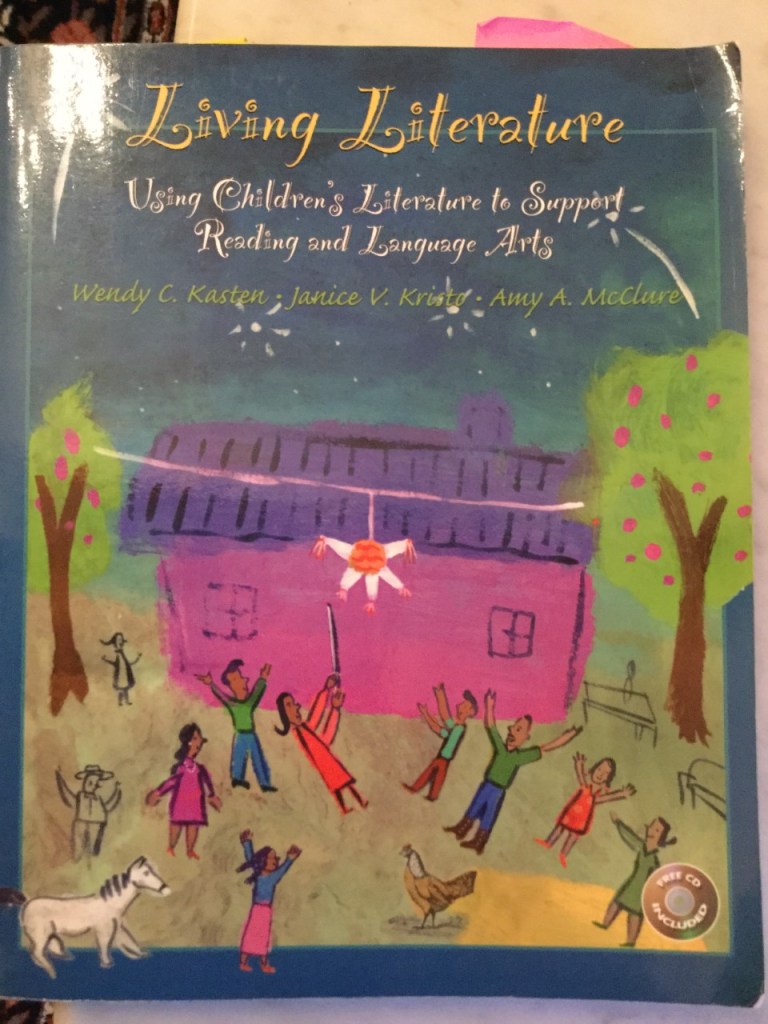
In 2005, I co-authored a textbook on Children’s Literature with Pearson Education, which was moderately successful. So, using my knowledge, I have created here a presentation to fill you in, writers!

HERE GOES: What is children’s literature?

Children’s Literature (fiction, nonfiction, poetry, traditional literature) is roughly defined as preschool through about age 14 -ish. In schooling, that includes older preschool (3-5 year-olds); Elementary School, and Middle School (which can include Grade 8). Literature written for kids older than middle school is called “Young Adult.” YA is a bit more sophisticated, more complex, often contains more mature content (like romance, drugs, sex). It is important to understand however, that these divisions are somewhat artificial and approximate, because younger kids may get into YA books before they are 14 years old.

FIRST OF ALL – FICTION VS. NONFICTION

FICTION – A MADE-UP STORY, WRITTEN IN NARRATIVE (AS OPPOPSED TO EXPOSITORY) The confusing thing is that the word FICTION is also used to denote something untrue. Fiction, as the literary genre is not factual, but it is full of many truths. Fiction is sometimes called “Human Experience in Narrative.” I got that definition from Katherine Paterson. The lady us brilliant. In addition to her credible list of award-winning books, check out her essays, writers. THE GATES OF EXCELLENCE and THE SPYING HEART.

NONFICTION – Books that are factual, informational, generally written in expository text (as opposed to narrative). Nonfiction often includes things like: A Table of Contents, Chapter Headings, Subheadings, Index, Glossary, Bibliography (although some fiction has bibliographies)

Caption: Children’s Literature is not that old. Historically, publishers did no believe that books for children were a viable market. Exceptions were Beatrix Potter and her Peter Rabbit series, or A,A, Milne with this four books around a Winnie the Pooh toy bear. Theodore Geisel was hired by a company making reading textbooks for children to write for the “basal reader.” He instead published his creation as a trade book. The notion here was to write with a limited or controlled vocabulary to support developing readers. The field of children’s literature got a big boost from Dr. Seuss (Geisel). When this came out in the 1950’s, it sold very well.

Most books which have been written since the beginning of the printing press are NONFICTION. Library cataloguing systems are designed to organize and access nonfiction. There are SOOOO many categories such as:

  • Books on a topic (any topic imaginable)
  • Biographies
  • Autobiographies, memoir
  • Dictionaries and other reference books
  • Cookbooks
  • How-to books
  • Atlases
  • Encyclopedias
  • Instructional textbooks
  • Telephone directories (when that was a big deal)
  • Any kind of directory
  • Instructional manuals
  • Photo Essay

This a bit confusing? When in doubt to determine if a book is nonfiction or fiction, go to the COPYRIGHT PAGE in the book where you find the date and all that, and it will tell you.

“Juvenile Literature” means nonfiction.

“Juvenile fiction” means fiction

Either may contain “keywords” that relate to content.

THESE AWARD-WINNING NOVELS ARE HISTORICAL FICTION, BASED ON THE AUTHOR’S FAMILY HISTORY, BUT THEY ARE STILL FICTION AS THEY PRIMARILY TELL A STORY.

Form vs. Genre

Genre is based on what the book is about. Nonfiction is a genre. Subgenres within nonfiction are biography, manuals, reference books, informational books, guides, etc.

Fiction is a genre with a bunch of subgenres. Contemporary Realistic fiction is set in the present. Historical fiction is set in the past (where that past begins depends on the age of the readers and the intent of the writer, and the age of the book. Little Women is now historical fiction because it’s been around so long, but it was contemporary fiction when Louisa May Alcott wrote it. Fantasy is a story containing magical or supernatural elements, such as magical objects, time travel – anything not possible in real life. Science Fiction is speculative imagining a scene, place, or future time with differing technologies or worlds. Science fiction MUST be rooted in sound and accepted scientific theory (or else it is fantasy). The generations of Star Trek on television is a common example of science fiction, as their ships, stories, and encounters have been theorized.

There are subgenres in adult fiction that do not appear in children’s literature: Romance, Horror, would be two examples.

FORM is how the book is presented. A novel is a FORM. Poetry is a FORM. A Pop-up book is a FORM. AND a PICTURE BOOK is a FORM.

A picture book could be POETRY if the text is one long poem.

A picture book could be Nonfiction biography is its about Nelson Mandela, or Barack Obama, or Florence Nightengale,

A picture book could be Traditional literature is it’s the retelling of an old folk tale, or other traditional story, such as The Three Little Pigs, or The Blind Man and the Elephant, or Brer Rabbit, or the Legend of the Bluebonnet (flower).

A picture book can be a Alphabet book, which is a nonfiction form. The topic of the alphabet book might vary greatly.

A picture book could be a charming made-up story, which many of them are, such as Strega Nona, or Click Clack Moo.

A picture book could be Historical fiction, loosely based on something real in history, such as Train to Somewhere.

MORE ABOUT THE FORM CALLED THE PICTURE BOOK

A true picture book has 32 pages. This is because it is comprised of to signatures of large paper that has been folded into 8ths, using both sides makes 16 pages, two signatures add up to 32 pages. This applies to hard over editions which generally have a sewn binding, a rigid spine, and endpapers. These features are lost in paperback editions, which accounts for the differences in price.

Endpapers are not counted in the 32 pages. One side of the endpaper is pasted into the front cover. Same in the back. Endpapers are normally a different kind of paper, and may be plain, or decorated to accompany the theme of the book.

Picture Books rarely have more than 1200 words. For younger readers, a few hundred words is common. There are exceptions.

Picture book are illustrated AND in a high quality picture book, the expectation is that the art and the text work together to create the nuance of this unique form.

It is common for picture book writers to submit their work, and for the editor at the publishing house to choose the illustrator. Often, authors do not see illustrations prior to publication. The illustrators are given license to bring their own creativity and expertise to the text – making the final product a unique collaboration.

Some folks are both authors and illustrators. Typically, the text of the book is accepted for publication without the illustrations, or with only a sample of the illustrations.

Caption: These are all picture books, but represent different genres in the writing. Planting the Tres of Kenya is nonfiction; Big Anthony is fiction – a charming made-up story; Same with Don’t Let the Pigeon Drive the Bus. While One Candle is historical, telling of memories of the holocaust; Willie and the All-stars is a story but Floyd Cooper tells about segregation in sports; The Greatest Power is an Asian folktale retold by Demi; Gingerbread Baby (Brett) builds on the folktale of the Gingerbread boy, but is a made up story. Picture Books have different trim sizes. Note several have “landscape orientation” and others have “portrait orientation.” These design decisions are generally made at the publishing house, along with the selection of paper, layout, etc.

Uncategorized

Giving Away Books

Giving Away Books

Those of us who have been reading all our lives, loving books, and accumulating books sooner or later have a problem. We have shelved our books like trophies, showing our tastes, tugging at our hearts, reluctant to part with them.

Here’s the problems.

We get old.

We run our of space to store them?

There’s a limit to how many bookshelves any home can hold.

Who’s going to clean up all the books when we have to go to a nursing home? Or, when we pass on?

I found a solution!!!!!

Here is Maine, libraries are locally funded. Therefore, some towns have a library and some do not. Usually when a town has no library, it takes the determination of concerned book-loving citizens to get one going.

That’s what happened here, in this county. A group of fiercely determined women made a library, where there was none. AND, they,

  1. Made two AIRBNB units above the library to generate income to support it.
  2. They made the library available to serve not just one, or two library-less towns, but SIX! Yes, the people (and children) in 6 Maine towns now have a library where before they had none.

Of course, they have an inviting children’s room. SOOO, I have been donating them many, many books from my home. Here’s the thing:

These books have been sitting behind glass for years.

Now, they are getting into the hands of children and their families.

They can get requested by intern-library loan – anywhere in Maine.

The miracle library in question is located in Unity, Maine. It’s lovely, and welcoming, and most importantly – OPEN! Staffed by volunteers.

Now, retired booklovers. What matters more – books on your shelves, or books available to be read by others?

I feel certain my books are happier.

Uncategorized

Going somewhere? How to pack and prepare for traveling

Traveling is exciting – but it requires some planning. After all, we want to be comfortable away from home. Here, I outline some of my own rules for packing – learned after 50 countries, 22 trips to Europe, 5 to Asia, and lots of places in between (not to mention a thousand conventions and conferences within the United States).

Traveling for business or leisure (or a combined trip) has some things in common and a few differences. I will address as many as I can. NO matter what sort of trip is coming up, one thing that applies to all packing, and is your first critical decision is…shoes.

SHOES

You will be miserable if your feet hurt. And I would caution against buying any new shoes, unless you are weeks away from departure, and you can really really break them in and ensure they will not give you blisters or worse.

  1. Decide on the right sort of shoes for the trip. They must be comfortable and versatile.
  2. Never travel with ONLY the shoes you are wearing in transit. Something could happen to your shoes. Like stepping in bubble gum on a sidewalk. Like having your feet swell and the shoes become too tight.
  3. Packing a pair of flip-flops is a good idea. You can wear them in the shower if needed, to the pool, as bedroom slippers, or home if suddenly your shoes do not fit (Yup, that happened to me – all the way home from Greece. Good thing it was not winter).
  4. You may need one pair of shoes for a special event, like a reception. Shoes take up lots of space, especially for men, so consider carefully.

COLOR SCHEME

Plan your clothes in a color scheme, so mostly everything can go with mostly everything else. Most things in your suitcase should be versatile, with the possible exception of some special outfit for a big event (like if you are accepting an award, or chairing something fancy). Here are some suggestions.

  1. For women – a scheme of black and white with an accent like pink or teal; blue and white with a few red accents.
  2. For men – A palette like navy and khaki; Consider one very nice blazer, in either tan or blue with pants and shirts favoring the other color. Other schemes might be blue and gray, for example, or black and tan.

PLANNING THE WARDROBE

You will need one outfit per activity day -but some items will be used more than once. Then, one way to dress up if needed (especially if it’s unexpected); one way to dress down for exercise or the ride home. If you are gone for more than one week, plan on getting laundry done once per week. All hotels offer laundry services. If you are in an rural eco-setting, pack soap to wash essentials. This keeps your luggage light.

  1. Start with something to sleep in. A raincoat could double as a bathrobe. Flip flops could be slippers.
  2. Always have one extra shirt in case someone spills their wine on you, or a waiter trips and spills fish sauce on your clothing.
  3. If that blazer or sport jacket is leather – it is easily wiped off if something spills. A good investment for traveling.
  4. Women travelers – carrying a wool or pashmina shawl can serve multiple functions. Throw it over your coat for added warmth on a chilly evening; Throw it over yourself on the airplane when the air is too much; it’s available to create an evening wear outfit if needed.
  5. Consider the fabrics in your wardrobe. Many travel fabrics require no ironing. Silk is a wonderful fabric for travelers – men and women. It has minimal wrinkling, can be warm or cool, and dries quickly in a hotel bathroom overnight when needed. It takes up very little room in a suitcase. If purchasing something new in silk, wash it prior to travel to ensure it does not shrink. Travel catalogues like Travelsmith and Magellan offer helpful travel clothing and gear.
  6. Dress for where you are going. Consider the weather, temperature, and customs. For example, in much of Africa, local women never wear pants. In much of Europe, only children wear shorts – not adult men and women.
  7. A lightweight packable tote bag – not just for shopping (many places in the world do not offer plastic or paper bags for shoppers); but for long touring days, it can hold a water bottle, and other things you need with you for the day.
  8. Consider packing one plastic hanger, a length of string or bungy cord, a hand-sized towel.
  9. Anything liquid should be within a zip-lock bag.
  10. Nail clippers could also cut a tag, or piece of tape if needed.
  11. A small roll of duct tape. Your luggage could become damaged in transit. Duct tape will generally help it get home in one piece.
  12. For women especially, don’t pack a suitcase you cannot easily lift. There isn’t always help available.
  13. DO YOU NEED A HAT? Many places you go, hats are important. Consider packing a crushable hat.
  14. For traveling into buggy places with mosquitoes, for example, consider acquiring some insect repelling clothing carried by most outdoor clothing vendors, such as L.L. Bean.

PLANNING THE PERSONAL ITEMS.

These are different for every individual. What medicines are needed? Toiletries? Makeup? These things will help determine if you are comfortable on your trip.

Medicines – Make sure you have what you need. Any controlled substances need to be in their original containers. Pills – have always 1 or 2 extra in case one drops onto a floor, or you are delayed getting home. With any medicine, be sure your supply is ample to accommodate delays, and accessible in transit. I like to arrange vitamins for each day in little “pill pouches” available at most drug stories. They are about 2 inches by 2 inches in size. These pouches can also hold just a few of something you need sometimes – like tylenol, or advil. Sharpie markers write well on these pouches.

Traveling Outside the United States? You could be sensitive to local water. In a developing country, water may not be safe for travelers. Ask your primary care provider for a prescription of CIPRO, which you would take if you ingest unsafe water by accident. Ask questions about the water where you are going. Drink bottled water where the cap is still clearly factory sealed.

ALL important items must be stowed in your carry-on bag (which of course may end up under a seat or in an overhead space in transit). Especially medicines. If you are traveling for business, and there’s a presentation in your near future, or meeting, have what you need in your carry-on.

DUCT TAPE – Real silvery duct tape comes in a small version, same width, but not very much tape on the roll. Consider packing some. I cannot begin to list the possible uses for duct tape during travel. One example, would be if your suitcase zipper busts. You may not be in a place to buy a new suitcase.

SUNSCREEN – For those on outdoor adventures, and even just touring around a town, sunscreen is an important protection. The tricky part is that it often comes in containers too large for the 3-1-1 bag. Look around for small containers of a good quality sunscreen product.

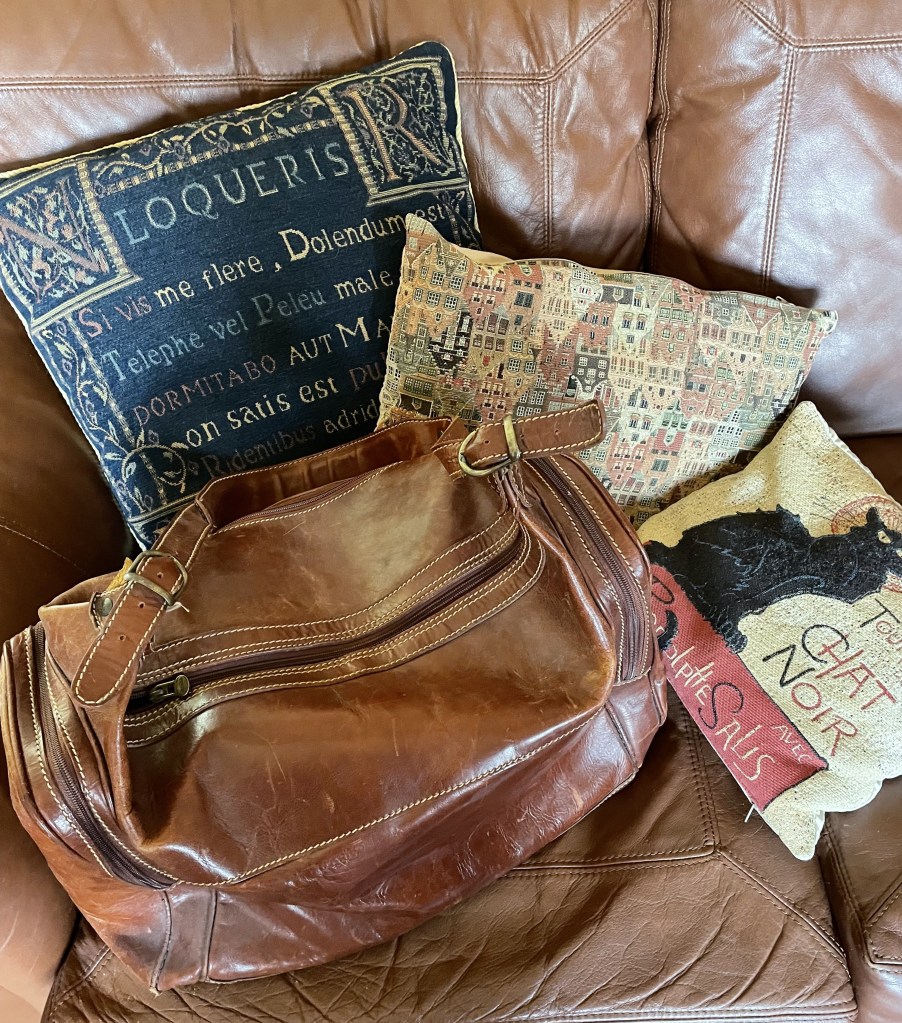
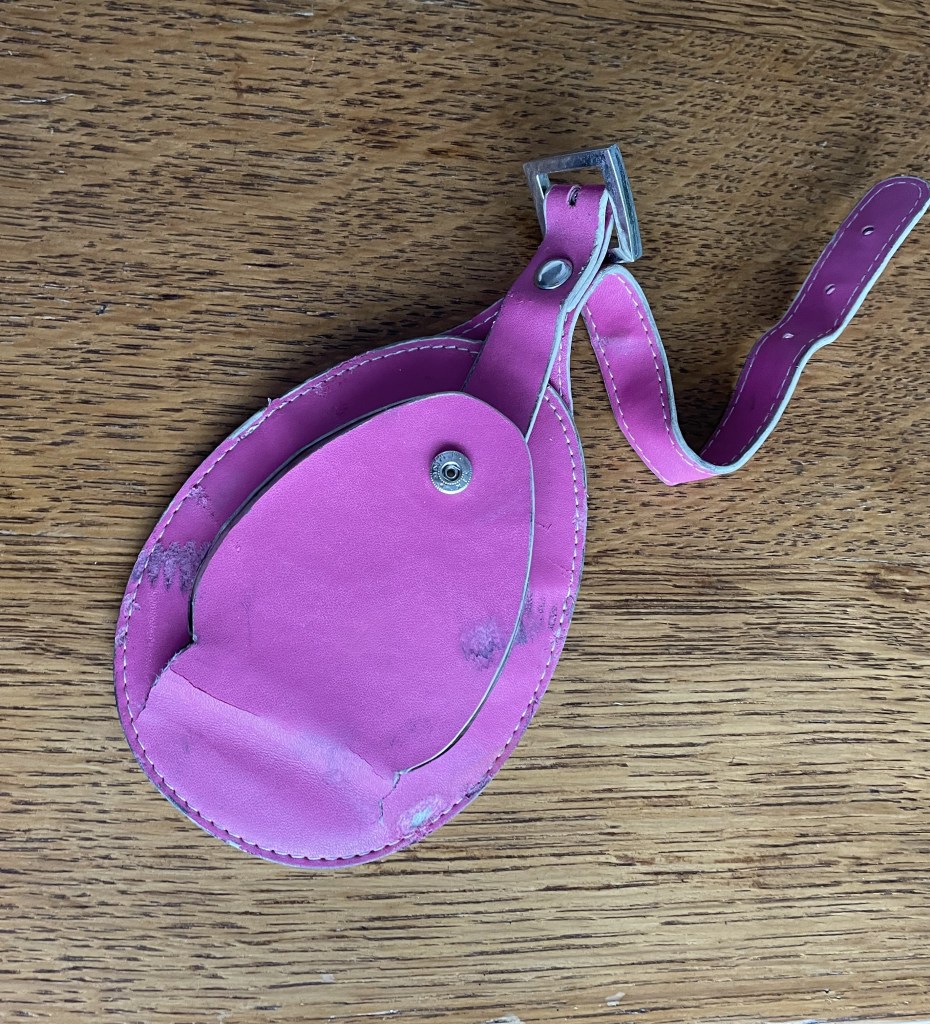
Caption: Many suitcases look alike. A bright tag can help your luggage be recognizable. Make sure the information on the tag (hidden here for security) is up to date.

THE CARRY ON BAG

Traveling far? To an remote area? Put one change of underwear and a clean shirt in your carry-on bag, sealed in plastic, perhaps lining the bottom. Luggage can get lost. The farther you go, the better chance of its delay.

Remember to avoid anything prohibited by TSA if traveling by air. Carry a small container of clean water (after you have been through security), snack foods (schedules are subject to delays), anything you need to remain comfortable. I pack a book, a small notebook, pen, hand cream, chap stick, a paper towel or handkerchief (yes, they still make them), tissues, phone, items for entertainment (like ear buds; crosswords). Some frequent travelers always carry a sleep aid, in order to adjust to time changes more quickly (by getting to sleep when it’s time).

Probably you don’t need a full container of most things. Often people buy a new bottle of shampoo for a trip, for example. Unless you bought the little travel size, you probably don’t need that much shampoo. Instead of packing a full container, pack a nearing-empty container, which can be disposed of in transit.

The little zip-loc types bags are available in most pharmacy stories. You may want to pack some just-in-case Tylenol, or Advil, or Melatonin. Or, use these to organize vitamins you take daily. A sharpie pen can write on the plastic. See the photo.

Caption: Packing a small amount of stuff you may need to be comfortable and to stay well is a good idea. Many people have difficulty sleeping during travel, especially after a long flight. Consider something to help with sleep if you believe you may need it.

The longer the trip, the more likely delays. Have some food with you. Nuts, granola bars, dried fruit are all good options if they work for your diet needs.

Caption: I would never begin a long trip without some food in my carry-on. Sometimes I have been delayed for a long time in a place where no vending is available, such as a plane sitting on a runway waiting for a backed up queue for departure.

IF you are presenting shortly after you arrive, or have other business responsibilities, everything you need for the meeting or presentation needs to be in that carry-on, such as your laptop, ipad, USB drives (always prepare more than one, they can break after your first presentation when you have four more to go).

Caption: In this picture, note the tiny plastic zip-loc type bags useful for packing small amounts of pills.

THE 3-1-1 BAG

For air travel, the 3-1-1 bag is required by TSA for liquids and gels. Check your airline website for details. If you take liquid medicines, like eye drops, that bag can get filled real fast. Often health food markets carry hair shampoo that comes in a bar like regular soap, and therefore does not need to go into that little bag. Any liquids in your luggage should be additionally secured with a plastic bag in case caps fall off. This only applies to luggage which is checked. If you carry on your small suitcase which fits in the overhead bin, then your ONLY liquids and gels are in the carry-on bag.

POWER DIFFERENCES

United States small appliances will probably not work in countries outside North America. Travel sites sell step down chargers/adapters (which convert the power) and outlet plugs with the correct configuration of pins. If you skip the charger, you may ruin your appliance (tablet, razor, hair curler, phone, etc.).

THE LUGGAGE

Whatever sort of luggage you select, the same principles apply.

First, anything in packaging takes up more space that the items alone. Foe example, perhaps you bought insoles for the trip, and they are still in the box. Or maybe you bought last minute tylenol, and the bottle is also in a box.

The more structured the container, the more space it uses. Things in pouches that can flatten out are better options.

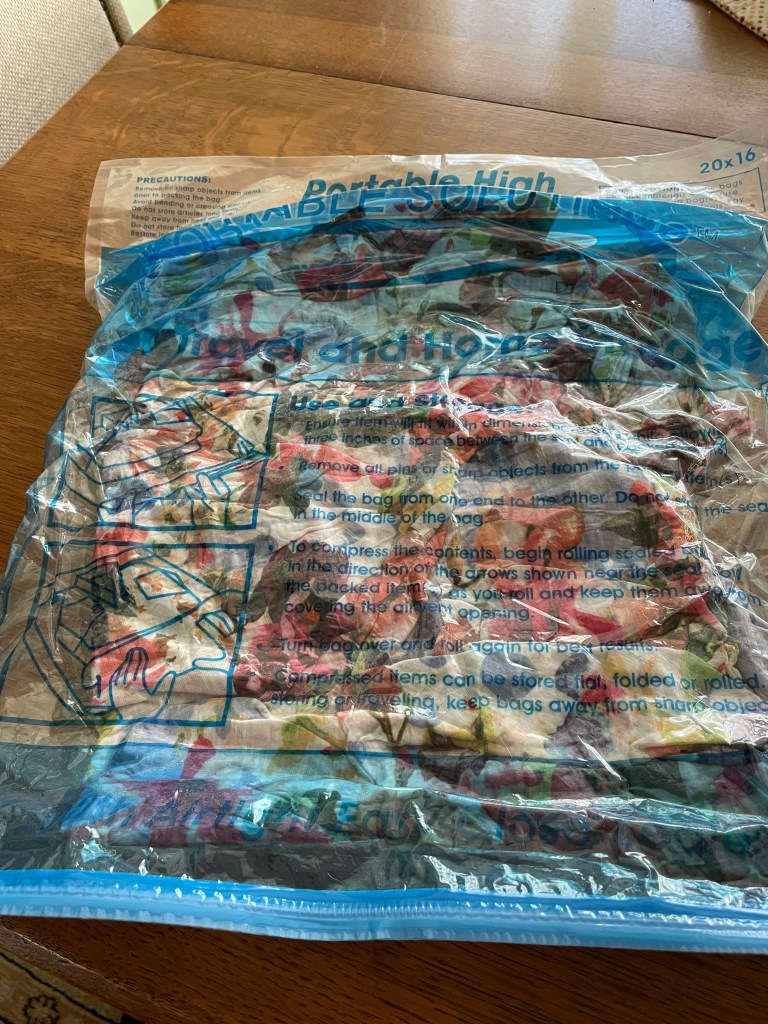
Plastic bags with baffles can be useful. Some travelers put each outfit, or at least clean shirts in one of these. You lay the garment flat as possible in the bag, which in the case of a dress shirt would be carefully folded to avoid wrinkles. Then, you roll up the bag. The baffle lets out air, making the finished back very flat. See the photo.

Caption: These bags are a good tool for travelers. One photo shows one empty, the other with a shirt inside. They are available in travel stories.

The principle for packing most stuff is the least amount of folds possible. In other words, do NOT fold tops. Fold pants minimally. Lay things in one at a time, folding over a sleeve for example, but keeping most things flat.

There are travelers who believe strongly that rolling items is a better idea. You decide.

Pack your suitcase at LEAST the night before, and stand it up. Gravity will pack things down and give you a bit more space.

It’s not a bad idea to pack the suitcase well in advance, to ensure the things you need fit, then take it apart, and repack it with what you really need.

MONEY, SAFETY, SECURITY

Always have some local cash, especially if you are going far. You may need something right away, like a bottle of water, or a luggage cart, which can only be purchased in the local currency.

Nearly all credit cards work around the world – as long as you inform your card company of your plans. Generally a phone number on back of the card will give you access to the information you need.

Some cards charge still fees for foreign transactions. Check to see if your card does, because you may need a different card for travel.

Caption: Pouches like this with multiple compartments work well for packing jewelry, or dealing with multiple currencies. They use less space that rigid containers.

Always travel with at least two credit cards in case one is lost, stolen, or stops working. Keep them in two entirely different places. Have your card numbers and those needed phone numbers on the back of the card in a location you can access while you travel. Some folks put all this in an email to themselves. Inform your credit card company you will be traveling- using the phone number on the back of the card.

Cash machines, which go by different names, are available in most areas of the world. Consult your bank to ensure which ones will work prior to departure. You may need to swipe or insert your card to gain access to a money kiosk which is secured behind locked doors. Take out cash before venturing into a remote or rural area where machines are less likely available (such as on an African safari, or exploring the Australian outback).

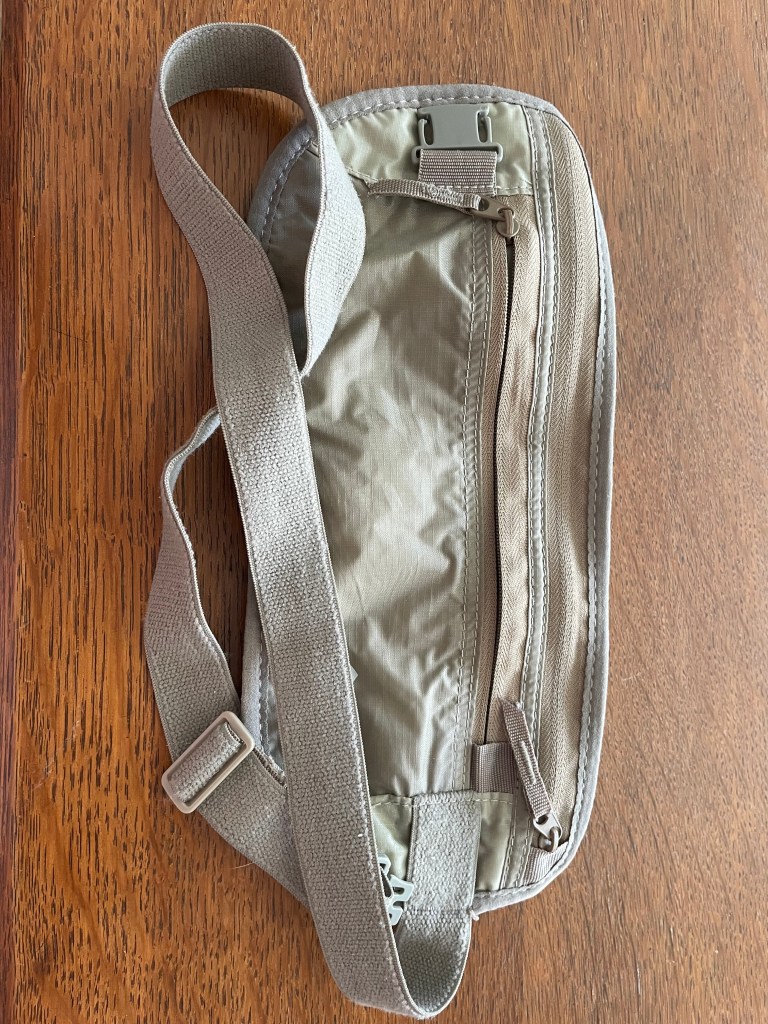
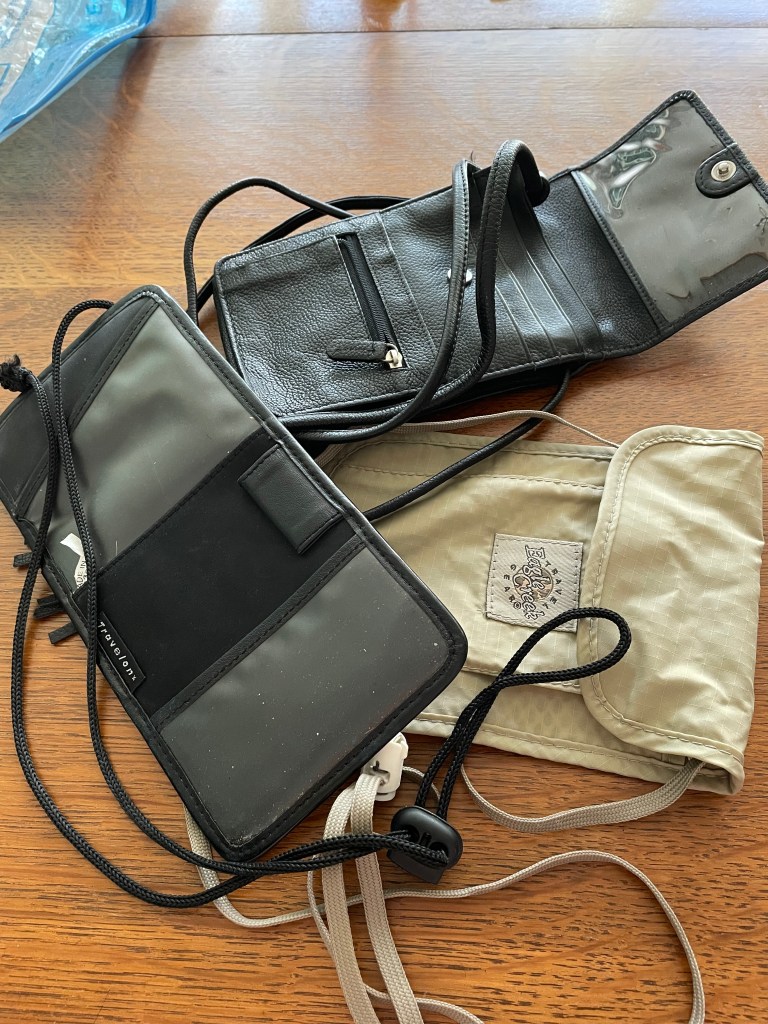
In transit – especially if you may want to nap, consider carrying money, cards, passport, and anything else critical in a pouch you wear all the time – even tucked inside clothing.

Caption: This money pouch goes around your waste and slips under clothing.

NEVER leave a purse, briefcase, backpack, camera case, or tote bag unattended while you sleep or move around.

Women travelers – NEVER hang your purse on your chair back in a restaurant. Place it at your feet, keeping one handle around a foot, or ankle. Pickpocketing and petty theft are common in some countries.

NEVER leave your purse at the table when you go to a buffet in a restaurant unless you leave it with a trusted person who knows it must be attended carefully. A common tactic among thieves is for a group to enter a restaurant and cause a distraction, and while you are looking to see what’s going on, someone else is collecting purses, wallets, cameras, etc.

Caption: Here are some wearable items to carry valuables around your neck at all times (except when going through Airport security).

PASSPORTS and VISAS

All foreign countries require passports that are current, do not expire within 6 months, and have empty pages for stamping. Some frequent travelers must visit a consulate to have pages added.

Some countries require VISAS in addition to passports. Sometimes you must apply in advance and pay a fee. Sometimes you pay a fee at the airport when you arrive and your passport is stamped (but not the same line you waited in to have your passport checked and stamped upon arrival). Check in advance how things work.

It can be fun to accumulate lots of stamps from around the world.

HOTELS AND OTHER ACCOMODATIONS

Staying at an interesting hotel is great fun when traveling. Know in advance that credit cards are often charged in advance for a booked stay in most countries outside the United States, even long before departure. Changes in itinerary, such as a delayed flight – you will probably still be charged, and there is nothing you can argue about. Never use a debit card for a hotel booking, as the card will cease to work until after your departure. (And debit cards for no enjoy any protection under U.S. Law, which credit cards do).

Two-star properties (**) are often a good value. They maybe family owned, quaint, and less expensive. Travel memberships, such as Best Western, Choice, Starwood, Hilton Honors can assist you in making bookings and, when it’s time, to use your bonus points.

Bed and Breakfast Inns are often a delight, with quaint accommodations and helpful innkeepers. When choosing alternate accommodations such as “Home Away” or “AirB&B” or VRBO, it is important to keep in mind you may have little or no contact with anyone in hospitality – no one to make recommendations, help you know where to go, where not to go, help with your return flights, assistance if you lose your purse, luggage, or are the victim of a crime like pickpocketing.

TRAIN and BUS TRAVEL

Train and bus travel are sometimes a better value than air travel between countries. Europe, for example, observes First and Second class distinctions and prices on trains. Be sure you know in advance what countries your train crosses, as some borders stop trains and demand additional fares in cash from travelers. The cleanliness and condition of land travel transportation in various countries can be different. Guide books and sites can inform you in advance of what you need to know.

TAXIS

Taxi service varies greatly around the world. Much of it is unmetered. In other words, you don’t know how much the ride costs until you arrive at your destination. Consider asking your hotel for help calling a taxi, finding out the exact price in advance, and have exact cash prepared. Many taxis around the world do not have the capability to take credit cards and other online entities, such as Venmo.

Tipping is almost universally expected in taxis wherever you travel.

One common Taxi scam if, for example, you give the driver a $20 (or equivalent in local currency, for them to hide the $20 and claim you only gave them a $10 (which they have conveniently handy). If you suspect a driver, take a photo of the driver and the license tag as you depart the vehicle. Some countries have tourist police dedicated to keeping visitors safe.

Know Before You Go!!

EATING AND DRINKING

Sampling local foods is a joyful part of traveling. Be thoughtful about what you put in your mouth. Lower GI distress has ruined many a vacation or business trip.

If water locally is unsafe, eat things like soft boiled eggs rather than scrambled (they may have added water); bottled wine or soda or beer; well cooked meats. Do NOT order drinks with ice cubes, mixed cocktails, or salad (it was washed in local water). Cooked veggies are probably all right. Always ask if the water is safe for brushing your teeth. In a city like St. Petersburg, Russia, for example, the mass graves from World War II have leeched into the water supply, making the water non-potable for teeth or anything on your face, but suitable for showering (if you can keep water out of your eyes and mouth).

Hot coffee and hot tea are generally safe.

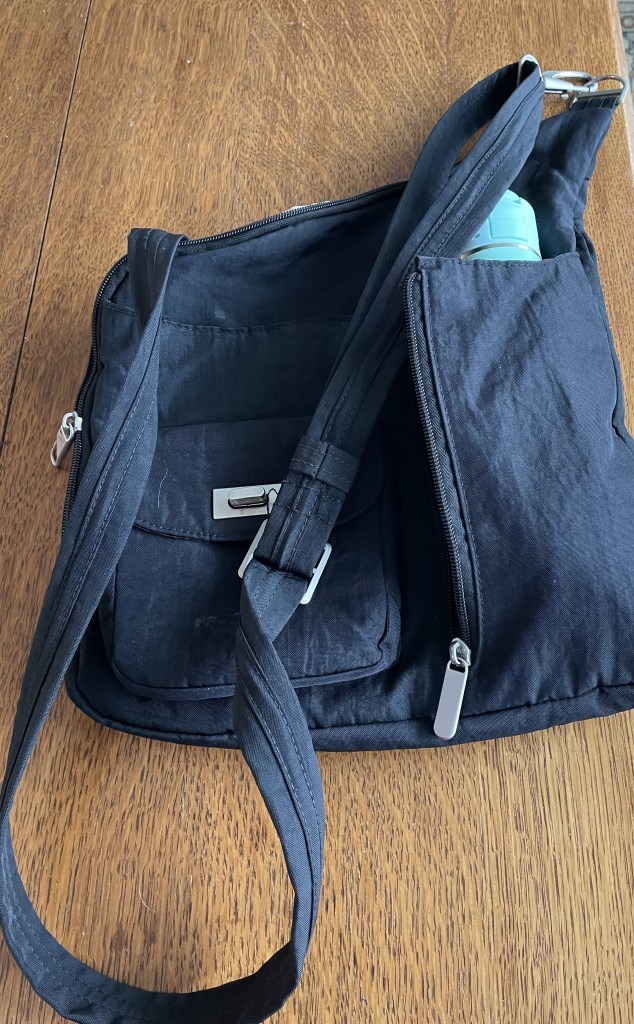
Caption: A travel purse, day pack, or tote bag may be a good choice – especially on with a place for a water bottle – for activities during the day. This needs to be packable into your luggage for women, as this would count as your carry on, and it probably doesn’t hold enough for that purpose.

Consult a guidebook to find out about tipping is restaurants. In Australia, for example, servers earn real wages and are not supported by any tips. In other countries where tips may be expected, they must be cash and not added to a credit card.

Once you’re out of a big city, vendors and hotel workers may speak little or no English. Be careful ordering, and never assume something where you are is the same as back home.

Example 1 – I was eating at a nice restaurant in Cape Town,South Africa and a teacher friend ordered Ostrich steak. She didn’t like it, so asked for something else. She was shocked when she was charged for both meals. The server pointed out she had eaten some of it, and they could not resell the ostrich steak. She had to pay for it. Another person at the table requested A-1 steak sauce with her steak. The server had no idea what she was talking about. This product did not exist in South Adrica.

Example 2 -In a small danish village, the menu was arranged by numbers, and each number was a complete three course meal – no mixing and matching. My co-traveler wanted the broccoli from Number 1, the meat from number 2, the dessert from number 3 and something else from meal number 4. If it was even an option to mix and match, certainly the server knew little or no English and my dear friends was brought all four complete meals. The table wasn’t even big enough for all four plates (and I had already ordered just a single meal). We still laugh about this today. It was an expensive lesson because, of course, she had to pay for all of them.

TOILETS

I cannot express my surprise the first time I went into a public restroom (I was in Singapore) and opened the door of the cubicle, and there was nothing but a hole in the floor. So you don’t feel like an idiot, the protocol is you stoop over the hole, facing the door. Paper is sometimes provided. Hard on knees!

It’s a great idea to always carry tissues or a partial roll of toilet paper wherever you go. In many places, rest rooms have an attendant, and you are expected to put some local coins into a dish on the sink. Still other places (like Thailand, for example), you purchase a small wad of toilet paper prior to entering the cubicle.

Some public restrooms will have one cubicle with a traditional toilet, if you know to look. There may even be a picture of a toilet on a door.

Carrying hand sanitizer is another good idea. Soap may or may not be available.

I have often thought a great title for a travel book would be “Fifty Ways to Flush a Toilet.” You may have to really look around to find how to flush. It could be something above you, on the floor (something to step on), behind the toilet – anywhere. Or, in a rural area, it might be a scoop and a pail of water.

CUSTOMS

This topic is enough for a course. I strongly recommend consulting and reading a guidebook before you travel. Often, guidebooks are available to download to your kindle app on your phone.

One thing I will mention is especially for unmarried women traveling without a male partner. Marriage is so strong in many cultures that single women make no sense to local people – especially in African countries, Middle Eastern countries, and anywhere where the Muslim faith is dominant.

Ladies, consider going to an estate jeweler and purchase yourself a simple wedding ring and wear it during travel depending on where you are going. I do not think men need to be concerned with this.

Other customs to read about in advance: tipping, restaurant manners and protocols (such as you may never be handed a bill for your dinner until you request it).

ATTITUDES

Be a humble traveler. Never talk down to local people. They will notice. Never act like you are better than anyone else because maybe you have more money than local folks. Treat everyone you meet with respect. Don’t be surprised if they know immediately where you are from. Clothes, shoes, jewelry, and even smiling are all cues to locations (Lots of folks are not smiley, which may have to do with the condition of their teeth, or just what is locally normal).

GESTURES

Be careful what you do with your hands in a foreign country. Giving a thumbs up, for example, may be something sexual. Observe what local people do.

Caption: This gesture in the US means “okay.” In Turkey, it means you are a gay man looking for a partner, according to one informant.

DECLARATIONS

Jewelry, scarves, bookmarks, throw pillow covers, table linens are all very packable for the trip home. If you intend to buy art, consider packing a collapsible art tube. Most things can be shipped home of course. Something breakable? Either pack it separately and carry it on, or embed it in your own clothing for the journey home. A decorative plate or tray can be slipped about in the middle of your suitcase so it is cushioned from the top and bottom.

In countries selling carpets, I have been informed the carpets are considered art and are not dutiable. Check with locals to find out what is considered art, and what is not dutiable.

On the return from a long trip, I make a list on paper, such as in a travel journal or on your phone, of all my purchases with approximate prices (because they may have been purchased in a different currency). Save receipts from a larger purchase, such as gold jewelry. I think overall, it’s a good idea to be honest with the customs desk when you return home.

Once I brought home a great deal of books. I explained to the customs agent they were for educational purposes, he waived the duty.

When you read this, you may want to share some travel anecdotes on the comments. Please feel free. I will love reading them.

Radio Essays

The Pearls

The Pearlshttps://archives.weru.org/?s=The+Pearls

W.C. Kasten

The last week of June, 2006 was one of excruciating ups and downs. My brother Tom and I were waiting for our mother to die. Nurses said it wouldn’t be long. Meanwhile Tom, his wife and the entire family were also expecting the birth of their first grandchild – a girl.

Mom died the 22nd of June.  Local law required a wait of 5 days for cremation. So, on June 27, we got the call at 10:15 am that the cremation was complete, and to come and collect the ashes. Around 10:30, everyone got the call that Paige Elizabeth had been born.

“I wonder,” I said to myself, “if they passed each other in the light, in the space between life and death?”  Days later, my sister-in-law organized a get together in remembrance of Mom. My job was to transport our frail and deeply grieving father to the event. On one side of the room, a laptop showed pictures of Mom’s life. On the other side, another laptop showed first pictures of a birth. We sat Dad down and put his first great grandchild in his arms. It gave him a brief recess in his grief, and perhaps the last time we saw him smile.

Once the dust settled, I made an appointment with my favorite medium, Cynthia. I’d been out of town when Mom had passed. So I really hadn’t said goodbye.  I hoped to reach her through Cynthia, the same medium who had predicted a girl was coming to the family long before the parents made an announcement.

I had another question for Cynthia. Since Mom never met her great granddaughter, I bought a lovely red leather box, and put in it some things for Paige that belonged to her great grandmother. A sort of time capsule. I made Dad write something to put in the box, as he liked to write, and he needed things to do to get his mind off his grief.  I found one of Mom’s music boxes she’d collected, and put it in the box.  Mom loved Madame Alexander dolls, and I’d bought her the one named “Mary, Mary, Quite Contrary,” because her name was Mary. That went into the box.  I was struggling with what else to put in the box, which would be put away until Paige’s 16th birthday.

On the day of my session, according to Cynthia, Mom appeared to her immediately after an opening prayer, like she’d been expecting me. Her presence made me grab a wad of tissues. I told her about the box, and what would she’d like to have in it. Cynthia said she began talking so fast, it was hard to hear.

“She’s saying something about pearls, or a pearl, does this make sense to you?”

“Oh yes, I know exactly what she is talking about.” 

No one living knows that my mother gave me her strand of graduated pearls on my 16th birthday.  They had been a gift to her, from her oldest brother in 1934, who by then was a working adult, and who indulged his only sister, for her 16th birthday.

As soon as I got home, I took the pearls to a jeweler to be restrung and cleaned. I put them into the box.  The box is hidden in a closet in Paige’s home. On June 27, 2022, Paige will turn 16. She will get the box from her Great Grandmother, and I hope to be there.

Wendy C. Kasten

P.S. July 3, 2022

Last Monday, Paige turned 16. In order to be there, I had to board a god-awful early plane from Portland, Maine to Baltimore, rent a car, and rent a room. But last Monday on the 27th, we gathered family at a favorite family restaurant. Some of us were with Paige Saturday evening, June 25th, which her Dad, Peter decided was a better atmosphere to open the box. Paige seemed pleased. And for her birthday dinner on June 27, she wore the pearls. I gave her a photograph of her Great Grandmother Mary taken when Mary was in high school – wearing the pearls.

Essays, Uncategorized

Thinking of you, Valeriy

Ukraine flag

In the mid 90’s, following the fall of the Soviet Union, Kent State University, where I taught, began getting cohorts of students from former Soviet countries. They were all on Soros Scholarships doing advanced degrees in leadership. I was host and mentor to a vibrant, middle-aged wiry man named Valeriy. Val was born and raised in the Ukraine but spoke and identified as Russian. He characterized the change – with the fall of the Soviet Union – as an identity crisis. “I had to stop thinking of myself as Russian. I am Ukrainian.”

Val’s first challenge landing in the U.S. was how many choices he had to make. When he arrived, I took him to TJ Maxx to buy himself a coat. He was overwhelmed there were so many to choose from. When he found one he liked, it turned out to be reversible, and he stood in front of the mirror in the men’s department giggling with delight. “People back home will think I have TWO coats,” he declared.

Val also wanted to buy a camera, so we went to Wal-Mart. Again, he could not wrap his mind around making choices from many different makes and models. The final selection came down to which camera used batteries that would be available back home. Same scenario at the shoe store getting him boots. Then gloves. Then a hat. It was exhausting.

I suggested we grab dinner. We sat in a booth and were handed a twelve-page menu. His head started spinning again. “Order me something, please.” So, I did, but then the server asked him if he wanted baked, mashed or fries (and he didn’t know she was talking about potatoes); then she recited five different salad dressings and asked his preference. Again, he had no idea of what she was talking about. “Give him ranch,” I said to the server.

But, after all this, it was especially telling on another day when we went to a bookstore. It was Border’s books then – a large spacious store with two stories, an escalator, a café, and many, many books.

When we walked through the entrance, he stopped in his tracks, looked all around, and then burst into tears, covering his mouth, aghast.  Val had never seen so many books.

“Is it allowed to touch them?” He asked me.

“Yes, of course,” I said.

“Can you bring me back here soon and leave me here for the whole day?”

“Sure,” I said, trying to take in the enormity of what his tears meant.

Val also liked going with me to Sam’s Club.

In the store’s book aisle, we passed boxes of encyclopedias for $20 per set. Val stopped to examine them like rare jewels. “I need to buy these,” he was emphatic.

“Val, the reason they are so cheap is that now everyone uses digital references. They’re out-of-date,” I said.

“Yes, but where I live in Ukraine, these would be very helpful.” I talked him out of buying them.

But, he called the next day. He begged me to take him back to Sam’s club so he could buy three sets of encyclopedias, and soon –  before they might be gone. Two classmates from Soviet countries also wanted them desperately. We went. He bought.

One really big deal at Kent State University is the liquid crystal institute which hosts meetings with scientists from around the world. When Val heard of an upcoming event, he volunteered to be a translator. Three Russian scientists attended. Val invited those scientists to his dorm room, where he served some drinks and snacks, keen on the opportunity to make them feel welcome. The three scientists saw the three boxes of encyclopedias in Val’s room and begged to buy them from him. He relented.

Val called me the next day to share all this and express his urgent need to get back to Sam’s club to buy more sets of encyclopedias. We went. He bought more. He was ecstatic.

During Val’s academic year in Ohio, he had an opportunity to visit Washington, D.C. Upon his return, he was eager to share with me two entire rolls of photographs of the “Voice of America” building. There’s nothing at all special about the “Voice of America” building – architecturally, that is. Except what it meant to him.

He explained that he began listening to it in secret to the Voice of America when he was 17. He’d asked a teacher if this was allowed.  The teacher did not answer the question. His response was evasive. So, he felt he understood that the teacher was in a delicate position, and could not make a recommendation.

 In sharing the photos, he extolled – as if testifying to me, about the role of this radio station in the demise of the Soviet Union. He tuned in and came to understand things – things different from the information being doled out on official Soviet stations. He said all his friends began listening, without sharing with adults, what they were doing.

In his opinion, the Voice of America and the Chernobyl nuclear accident were the two biggest things that toppled the U.S.S.R. “It had been a beautiful day – the day of the accident. People were enjoying the out-of-doors. But suddenly on all television and radio stations, there was no programming – except the playing of classical music.” People wondered what was wrong. He went on to explain when they learned of the accident, they also learned the leaders of the Communist Party had evacuated all their own families to places far away from the radioactive area. That single self-serving act broke the back of the rhetoric that the government cared about its people. There was no way to spin that selective evacuation into something good for all Russians.

Going back to his trip to Washington, D.C.  he could not get over that he was allowed to tour the U.S. Capitol buildings as a foreigner, and that Congress was in session, and he was allowed to sit in the balcony, and nothing was being conducted in secret, behind closed doors.

Val’s academic year ended in May, and the Soros scholars prepared to go home. But Val didn’t show up for the ride to the airport. He went missing. This sort of thing happens regularly with foreign students. But no one knew where Val was. Perhaps others in the cohort knew but would not say.

Weeks later, Val telephoned. I was surprised and relieved to hear his voice. “Why are you overstaying your visa, Val?”

“I wasn’t ready to go,” he explained simply.

“What are you doing? No classes are in session.” I probed.

“Oh, I’m staying with a friend, and every day I go to the library, and I read.”

“This is what you have been doing for weeks?” I probed again.

“Yes,” he admitted. “There are so many books I want to read.”

This is where I was forced to explain that he’d put me in an awkward position. As a state employee at a public institution, I really could not condone his overstaying his visa.

“But call me when you need a ride to the airport. Not until then.” I concluded.

As a Professor of Reading, and a book lover, I could not fault his zest for books – and his desire to make up for what learning had been denied to him at home.

It was not a sweet ending to our friendship, however. Still, I am thinking about him now, every day, wondering where he is, and if he’s safe.

Val, if you ever hear this, I hope you know I am thinking of you.

Uncategorized

Searching for Love Poems – Full story

W.C. Kasten

            Another Sunday dinner is over – just the two of us. My 90-year old father shuffles down my hallway, then struggles with his jacket and zipper. He picks up the sack I have stuffed with leftovers for his Monday meal, dons his frayed Dutch cap, reaches for his cane, and gingerly totters to his car, every movement in slow motion. With Mom now in a nursing home, this is the best I can do, trying to make his life more normal.

            Each morning he gets up at his independent-living apartment, and makes his way to the social café for the breakfast buffet. Every morning, he has his oatmeal, orange juice and coffee. Then he gets into his car in the underground parking garage, just to drive the thirty yards across the parking lot to the nursing home. Then he finds her, his wife, my mother, somewhere in the hallways. Her soft skin jiggles a little as she smiles at the sight of him. My mother’s crisp white hair bounces as she tries to remember how to back up and sit down in a chair. Then they sit together in one of the lounges, doing nothing in particular. He sits with her until they call her to lunch.

            Two people come to help her get up. She leans into the walker, takes baby steps, and creeps to the dining room, her oversized pants pulled a bit too high, belying the plastic padding beneath.  She says almost nothing, and nothing she says makes any sense.  “That is…” and the rest of the phrase is stuck somewhere inside the crumbling mind. “I’m worried…” and she cannot find the other words.  “Sometimes you just…” and the remainder is never uttered.  Sometimes I try to help her. “You just what, Mom?” “What is it you are worried about?” But no amount of effort can lasso the elusive, the lost.

            Dad rises and escorts her to the dining room, and then leaves to go find some lunch for himself. Mostly, he ends up at the Senior Citizen Center where lunch is only a dollar. Dad has always loved a bargain. But the center is not open on weekends. He hates eating alone and so sometimes he just doesn’t bother. Afterwards, he might stop at Walgreens for one of their many prescriptions, or a stop at Urgent Care to have his Coumadin levels checked. Then, Dad returns to the nursing home.

 Once again, he finds my mother, sitting or wandering, or sometimes napping in someone else’s bed.  Again, he sits with her, or walks with her up and down the hallway. These rituals last until dinnertime, when the staff again call Mom to eat, and Dad goes back to his apartment to fend for himself and read the newspaper.

  Tomorrow will be a carbon copy of this.

            Another Valentine’s Day has arrived. This February 14th, Mom is in a hospital bed, coughing for her life with double pneumonia. I’d brought her some chocolate, which normally she loves. But in this condition, she’s hasn’t eaten anything much for days. Dad and I are standing at her bed, and she’s so deeply asleep, we decide not to disturb her. 

            I know for each of the last 64 years, Dad has written Mom a love poem for Valentine’s Day and also their wedding anniversary in June.  I don’t ask what he’s written about, or where this year’s poem is.  But suddenly it dawns on me that there are at least 130 poems. Love poems to my mother.

            “Dad, where are all the poems you wrote for Mom?” He shrugs his shoulders looking quizzical.

            “I gave them to her,” he says with resignation.  The thought of more than a hundred love poems either hidden or lost troubles me. We discuss cleaning out her things still at the apartment and trying to find them.

            On a subsequent evening, I go to Dad’s apartment to start cleaning. Dad has never lived alone, and his housekeeping is dreadful. So, fist I stop in the little apartment kitchen where I collect used yellowed paper napkins, polystyrene cups, and plates that are encrusted with old food, I deposit them in the trash, amidst his admonitions of “Hey, those could be used again.” Or, “That’s still good, I can eat it tomorrow.” I fear he will accidentally kill himself eating spoiled food on unclean styrofoam. Dad’s entire generation never recovered from the great depression.  Wasting anything is a sin.  I ignore his rants and I make my way to Mom’s drawers.

            First, the four drawers of Mom’s jewelry chest. I pull out the top one, set it on my lap as I sit on the edge of their bed with a large trash can poised nearby. What I find instead of jewelry are lots and lots of rusting hairpins staining the velveteen lining; an assortment of toothpicks; an occasional button or penny; old clothing tags with the price still almost visible; name tags from the “Sun and Fun” RV Resort Park in Sarasota, Florida; used up pencils and a crochet hook. The one gem I find is Dad’s U.S. Navy dog tags from the War. He smiles at the sight of them, as he hasn’t seen them for years.

I do this for each of the four drawers, and I find an occasional single earring back, a broken gaudy pendant, a plastic turquoise necklace. But somewhere stashed in one corner of one of the bottom drawer I find four of the love poems, brittle, torn, and mended with yellowing tape.  I stop and read them.  One of them is titled “May it Never End.”

I’ve said it very many times,

In many ways throughout the years,

Whether straight or set in rhymes,

Whether in laughter or through tears.

It’s been at night and during days,

So it may not sound very new,

Still I do not know other ways,

To once again say “I love you.”

            A couple of hours of this type of searching yields a few more poems, some glued to the inside of an old greeting cards.  Some are on a scrap of notebook paper, or an index card.  Some are typed on an old Underwood typewriter.

I searched for her throughout the world wide,

Crossing each continent from side to side.

Hoping that somewhere and someday I’d find,

The special girl who’d be loving and kind.

Failing I gave up nevermore to roam

To find my Valentine waiting at home.

A corner of the paper is ripped off on this one, so I don’t know the date, but I am guessing it was soon after the War.  We are still only up to twenty poems. Over a hundred more to find.

Scouring her dresser drawers yields a few more poems. These, hidden in an old purse, among a dozen pair of pantyhose all with runs, and among the now sticky decomposing nylon prosthesis Mom was supposed to wear where her left breast used to be.  Even back then, she said it was too hot and too uncomfortable. “I’m over 70,” she’d said more than a few times after the cancer surgery. “What do I need two breasts for?” When she wanted a left breast on occasions, she’d stuffed her empty bra cup with tissues, fabric, or a sock.

I think back to the last time, in earlier stages of Alzheimers, that I dressed them up for dancing. Dad had bought tickets to a big ballroom dancing event on the campus where I taught. Dad was in the designer second-hand suit that a friend had given him. This was the nicest most dashing suit Dad ever owned.

 Mom wore the frilly pink organza dress, also second hand she’d been given by a friend in the ballroom dancing club.   My parents got dressed at my house, and I helped Mom with her pantyhose and the buckles on her silver dancing shoes.  I had insisted she wear her prosthesis for this event, and so we had spent some time in front of the bathroom mirror, trying to ensure that the fake breast was aligned with the real one, and not four inches higher.  We never got it quite perfect, but close enough.  I took a snapshot of them that night, together in front of the closed draperies of my patio slider door, like two excited teens poised for their senior prom.

#

Following Easter weekend, Mom had rebounded from pneumonia, but with a decreased quality of life. Dad and I decided to move her to a different nursing home where there might be a higher level of care. Where her face used to brighten with the sight of us, there’s was almost no reaction now.  Yet, in the midst of her decline, there were mysterious moments of lucidness. I never knew what brought them on, but we both lived for them. The day we were settling her into the new surroundings, she turned and looked at Dad as he was leaving and said, “You know, I have never stopped loving you.”

During all this searching, we’d found a wonderful old photo of Mom. The photo was damaged, but it was of a seventeen-year-old, beautiful dark-eyed woman, hair curled around her face, and printed in an oval of light like the “Breck Girl” on the back of the old McCall’s magazines. My brother Tom visited that weekend. He had taken the photo home, scanned it, doctored it, and sent it by attachment back to me. I printed it and gave it to Dad. A tear slipped out of his left eye.

 “She really was beautiful back then,” he said as if he needed to convince me.

Another evening, I stop at Dad’s and continue my search for the poems. Even though I knock before I enter, he’s stretched out on his sofa, a crumbled paper napkin from Subway in his hand. He’s been listening to audio tapes of their old dance music.  I tell him I’ve got a little time to do some more cleaning of Mom’s things. That perks him up.

I start cleaning out Mom’s nightstand drawers. This time an entire drawer is devoted to over stretched out headbands in a variety of widths and colors. I find one poem on yellowed typing paper.  It’s dated 1986.

To My Wife

Now that life is in its downward journey,

When my day of living lies in the past,

I’ll be happy living in memory,

Because you’ve given me love till the last.

I’ll remember your smile and things you said,

I never forget your traits, both bad and good,

I see you laugh with a toss of your head,

As you teasingly in the doorway stood.

Shadows will flee as I think of your smile,

My thoughts will find cheer in the years we spent,

My dreams will travel along every mile,

Lingering on where together we went.

Though material wealth was not my own,

You brought me richness with the love I’ve known.

  Pausing to take it all in, I swipe a tear on my cheek. Then I find a good sweater that shouldn’t be in the drawer. So, I go and hang it in the walk-in closet. Mom’s side of the closet is getting empty, as I have been getting rid of clothing she will never need in a nursing home.

The frilly pink organza dress hangs at the end of the row all by itself.  The last time Mom wore it, almost three years ago, was at her Grandson Peter’s wedding. This wedding was elegant, in a fine hotel.  Dad dressed in the same dashing suit, and Mom in her pink dress they’d worn to the ballroom dancing gala seven years earlier.

  While Mom had absolutely no idea who was getting married, she could tell from the setting it was a wedding, and commented how lovely it all was.

 “They tell me you are my grandson,” she’d said re-meeting her grandson Peter at the reception.

“Of course, I am, Grandma,” he’d replied in good humor, giving her a hug.

We were at one of the biggest family events in decades and no one had remembered to bring a camera So, earlier in the day I had gone shopping and bought my first digital camera. Throughout the day, I was desperately reading directions, learning how to use it. Once we got to the reception, I kept it handy at my table.

At one point, the band did a cute number and had all married couples get up to dance. As each segment of the song passed, the bandleader would announce to have all the couples married less than 2 years, 5 years, 10 years, and so on to sit down. As the crowd was mostly young, I could see where this was going.

And so it went.  Soon Mom and Dad were alone on the dance floor. All eyes were upon them, the lights were dimmed, with the glittery ball spinning above them made prisms flit around the floor.  Dad forgot his aching knees, and led Mom in a waltz. Mom could follow Dad. They smiled and swirled and dazzled the crowd. At the end, the bandleader presented Mom with a nosegay of flowers. She had no idea why someone was giving her flowers but thought they were very lovely. Dad beamed radiantly.  I took the picture.

I returned to the nightstand and cleared out the last of the garbage. A few dozen pens that didn’t write. More hairpins, rollers, dirty tissues, rusty paper clips, safety pins, an occasional name tag, receipt, and a brochure.  In this session, I only found a single poem in a faded pink satin cosmetic bag.

To Mary

My love is yours through good and bad

It’s with you when you’re glad or sad.

A truer love will never be,

As everyone can plainly see.

Our love has stood the test of time,

For I am yours and you are mine.

From Henry

When all the drawers were cleaned out, there were still a hundred poems to go. I wondered where to search next.

Meanwhile, I’ll keep feeding Dad on Sundays. I’ll keep visiting my mother, watching her walk back and forth in the hallways with no destination. Dad will keep sitting in the nursing home with her for hours at a time. Until the next crisis when the next infection appears, or until the coughing resumes and we’ll go through all of this again, not knowing each time if we should be saying our goodbyes.  Each time as I’m leaving, I kiss her cheek, and tell her to sleep well, and to remember she has a family who all love her.

#

Mom passed first in 2006 at age 89. Dad was in poor shape with a heart barely pumping. His doctors had instructed us to take away his car keys. He learned to get around his neighborhood on a scooter. But, he was in agony without her, especially when Valentine’s Day came around. I think he didn’t know how to cope with their special holiday alone. So, he wrote Mom a poem, addressed the envelope to her, but sent it to my home address.

When I took in the mail that afternoon, an envelope addressed to my mother in my father’s handwriting made little sense. I sat down and stared at it for a few moments before I could bring myself to open it. There was just this inside:

ON LEAVING

You finally left this earth missing me,

To me, you and I shall remain just we.

Dying is a part of living and life,

Through all eternity you’re still my wife.

In all and everything I do each day,

Our togetherness will forever stay.

Dad passed a few months later. I only ever found 29 poems. His final request was that their ashes be mixed together and scattered in Vermont, where their married life had started. Tom and I fulfilled their wish the following summer. My brother read the last poem at our little ceremony. A fitting end to a very long love story.

Blog

Playing Tricks on Grandpa

Playing Tricks on Grandpa

Vermont was a sanctuary for Tom and me. After all, where we lived in New Jersey, you could not swing a bat to play ball without breaking someone’s window.  So the coming of summer was full of eager anticipation.  Space. In contrast to houses so close you could talk to neighbor’s without using the phone, Vermont had space. Behind the mid-19th century cape Dad and Grandpa had jointly purchased were acres of fields, a brook, woods, and so many possibilities.

  But our Vermont world also provided new challenges during those years in the 60’s (I was about 12, Tom about 15. Water had to pulled up from a well with pails that were weighted on one side to dip into the clear chilly water.  The sink in the cooking kitchen was dry. No faucet. Except of course when you sent dirty water down the drain.  Someone had added an electric stove to the kitchen (Mom was relieved). But clearly the eating kitchen had once been the cooking kitchen, because the big black woodstove was not only a heat source. We learned to add wood to the fire box. Set kettles on the round disk burners for tea.  Watch a needle on the oven door to see if it was hot enough to bake a pie. Mom was not excited to meet the wood stove. But Grandma had found an old and familiar friend, and she baked a raspberry pie just to test its prowess.

That’s the other thing about Vermont. In summer, we all lived like an extended family. The four of us, and our paternal grandparents.  Otherwise, grandparents were people who came to tea on Sunday, and were at our dinner table for every birthday, holiday, and sometimes just because. Grandma was the bringer of plum cakes, eclairs, Boston Cream pie, Jan Hagels, and raisin cake.  Grandpa , well, what we soon came to realize in Vermont is that we hadn’t known Grandpa very well. Not really.

Stannard, Vermont, in the Northeast Kingdom at that time did not get television reception. Radio reception was scratchy and annoying. It was said you could get a phone, but it would have been a 16 party line, and not often available. So Dad decided we didn’t need one.

 The house was well stocked with decks of cards, scrabble and monopoly for evenings. We wrote letters to friends back in Jersey. We read books.  We’d soon run out of the books we brought along. The one breadbox of toys we were each allowed in the over-stuffed station wagon served us well. I sewed doll clothes with the 1875 Singer Treadle machine we’d gotten at a church auction for $2.50. That is, after Grandma taught me how to use it.  In nice weather, Tom and I would be outside on our land. A brook provided hours of entertainment, tramping around soggy ground in rubber boots from the Army-Navy store in St. Johnsbury. We’d try to build dams to make a place for ourselves to swim. However, once we realized how naturally frigid the Vermont water temperature are, we abandoned our quest.

Nonetheless, sometimes, especially on a rainy days, Tom and I got bored.

Houses in the country have problems. Mice, for example. On one of those first trips to the hardware store in Hardwick, Dad and Grandpa stocked up on wooden mouse traps.  Grandpa, as we were learning, was often cranky. And he dwelled on problems. The mice were one of those problems worthy of dwelling. He set mouse traps under the kitchen wood stove, behind the Round Oak pot belly stove in the living room, and under the ugly oak hutch with the built in mirror.  Any place he thought mice might go. Dad moved some of them that our cat might trigger by accident. Grandpa had no understanding, sympathy, or adoration for cats.

Tom and I conspired on one way to annoy Grandpa. Our reasoning was, if Grandpa was so worried about mice, we should help him out – give him something to worry about.  In a way, we reasoned, we were being helpful.

First we found a roll of black thread in the drawers of that old sewing machine. The area carpet in the living room was all creepy dark colors – blacks and browns. Black thread was well camouflaged on that carpet.  Grandpa had to walk by the Round Oak stove in the living room to get to his little bedroom on the other side.  Tom and I strung black thread across the carpet. One end was tied to trigger a mousetrap.

As was predictable, Grandpa shuffled across the living room to his bedroom. Snap went the mouse trap! Grandpa stopped and looked around, and wondered where the mouse was. He was all excited about finally catching one.  He peeked under the stove. He was crestfallen that there was nothing in the trap. “Must have gotten away,” he mumbled.  Then he headed back towards his room, stopping to yank a piece of black thread from his shoes. He didn’t connect the two things (We didn’t get our brains from Grandpa’s side of the family). We, of course, were snickering beyond control around the corner in the next room. Mom and Grandma wanted to know what was so funny. After some thought, we told them. They just laughed with us. They did recommend we stop doing it, however. As I recall, we did not immediately take their advice. Tom was good at coming up with other ways to annoy Grandpa.

But that’s another story.

Radio Essays

The Jewelry Box

The Jewelry Box

One of the worst days of my life was when I had to put my elderly mother, several stages into Alzheimer’s, into a senior living facility. My Dad was in a Florida hospital near their home with a 50% chance of survival. I lived in Ohio, a single parent with a 60 hour a week job. My brother, in Maryland, had used up his vacation time visiting our folks the prior week at the beginning of this emergency. The place we found seemed just right. If Dad survived, he’d join Mom there. If he didn’t, she’d be taken care of. Mom was angry, even throwing grapefruit at me in preparation for the move. But once I had her settled in her new apartment with her familiar things, she calmed down. We tidied her clothes and dresser. That’s when she grabbed her jewelry box, dumped the contents on the mattress, and slid onto the bed to survey all of it.

               “There. This is my life. Not much to show for it,” she declared, a tear running down her cheek. She picked up her first small, delicate wedding ring. “I was very thin when we got married. This is all your father could afford.” She fingered a gold brooch with a center flower. “I bought this for your grandmother. During the war. I spent a whole week’s salary on it – $25.00. You should take this home, I don’t want it around here.” Then, a Delft pin, Dad bought her on a trip to the Netherlands; a golden locket with a broken chain that she thought had been her mothers. She went on and on, remembering each precious bauble – her favorite wristwatch, earrings from a vacation, a silver snowflake pendant from when they lived in Vermont.  All these memories when at this point, she’d forgotten how to cook, sew, and work the washer and dryer.

               Until that day, it had never occurred to me that a woman’s life is in her jewelry box. After all, whatever she has, most of it represents special occasions – a birthday, anniversary, vacation, holiday. Some gifts from someone special; some personal purchases to remember that big trip, voyage, festival or life event. And there’s the pieces passed along in a family. Like the gold brooch I still have. A concrete timeline of a life.

               I look at my jewelry box differently now. It’s a box full of stories. So many stories.

w.c kasten

Photo by Pixabay on Pexels.com
Short Pieces and Essays

Remembering Christmas

(taken from a letter I wrote to my Grandmother while she was in hospice in 1979)

Dear Grandma,

As I recall, the nights were always bitter cold on our noses and cheeks. I guess I wasn’t really dressed for the New Jersey weather in my Christmas party dress and black patent leather shoes. I don’t know for sure that they were always black patent leather, but that image sticks with me. Hats, mittens, and scarves were tucked around me, probably around Tom, too, as we hopped, danced, and paced up and down the sidewalk on Clinton Avenue in front of our house. Sometimes we were on cement, sometimes on ice and snow. The basic scene was always the same.

In back of us were lights around the door. Dad had made a frame to hold those larger size multi-colored outdoor lights. Bubble lights in a sort of candelabra showed in one window, to one side of the door. A gaudy lighted plastic Santa face graced the window to the other side of the door. Any number of yellow-bulb candelabras filled the rest of the porch windows which faced the street.

In front of us, cars whizzed by on Third Street to our side, and now and then an occasional car wandered up or down Clinton. Mostly, we were anxious, eager, and time seemed endless as we waited and waited for what seemed like forever for the car that brought you and Grandpa (and sometimes other relatives) so that Christmas could begin.

It took both of you forever to get out of the car and into the house. In – past the porch with all the lighted decorations. In – past the foyer door which each year I had painted holiday designs on the glass with my tempera poster paints. Into the foyer where the top of my piano had some sparkly flossy covering with various decorations on it. Mistletoe balls hung in the archway between the foyer and the living room. Wooden, red-painted reindeer pulling Santa’s sleigh ran up the bannister, which on the foyer side, held our Christmas stockings.

Christmas cards would hang everywhere – there were so many. Some would be poised on top of my upright piano. Others – the kind with the top fold – were strung on a string across the archway. Others might be scotch taped to the trim around doors and windows.

Mom on left, Dad on right, other relatives in the middle.
Tom, Me, our cat Frosty, around 58-59
Me in my Christmas dress, around 1956.

You always took such a long time to get settled. First, you went into the kitchen at the back of the house. There, you deposited a pile of friars made of specalaas. Each set on cardboard, wrapped in foil. When opened, the one for me was a Dutch Boy. The one for Tom, a Dutch girl. Raisins and currents made eyes, buttons, mouths and noses. Careful lines with a sharp knife drew on the costume details – the Dutch caps, necklines, and for the girl cookie, stripes on her skirt. The arms of the cookie were always with hands on hips – the space to define the arm carefully cut out from the body. Once, Tom complained about this, as the cut-out section meant he lost some valuable cookie. The next year, Tom got a big rectangular blob from you with a face. He was more concerned about the cookie amount than your artistry.

Next you deposited multiple loaves of Christmas bread also carefully wrapped in foil. Something in between white bread and fruit cake, your Christmas bread would get served later in the evening, slathered in butter.

Meanwhile, Grandpa wandered into the house with two or more department store shopping bags, laden with gifts. He would put them under the tree, or let Tom and me do it. Then everybody – all the grown-ups that is – would remark on how many presents there were, and then make some ridiculous chatter about how we should just leave them all there until next year. Tom and I were not pleased at such comments. The harder Tom and I tried to get the ball rolling, the more the grown-ups procrastinated with idle and meaningless talk. Someone would say, the later we start, the longer it will last. But the waiting was painful torture for me and Tom.

Of course, we were already scanning the size and shape of packages bearing our name on the cute red tags. We knew right away which ones were heavy, or rattled, or made no sound at all. Boxes that were more cube shaped were more likely to be toys. Flat boxes were more likely to be clothes, which was less exciting. One box always had new pajamas, which we needed anyway. Long narrow boxes could be dolls! That was the moment I waited for. And it there was a new doll, there was also, farther under the tree, a box of hand-made clothes for the doll. Mom would have sewn up a storm making the doll, pants, a jacket, a dress. You had used leftover yarns to knit scarves, sweaters, skirts, and tams for the doll. And it was glorious.

This Christmas has been very nice. My best friend – Martha, with her little girl Laura – and I went to the Christmas Eve service at the Universalist Church in Bangor. This candlelight service in a historic building began with the young minster saying that many of us had come here in search of Christmas. But, he said, you will not find it here, because each of us must find it for ourselves. The children sang a carol. The choir did a The Hallelujah Chorus. A young boy with a delicate golden voice sang “Whose Child is this?”

Everyone moved from pews to a circle around the entire sanctuary for candle lighting, with which everyone sang “Joy to the World” and “Silent Night” by candlelight as we all filed out and headed home in the wintery ice and snow.

Here’s wishing you the very special feeling of Christmas.

love,

wendy