Residents of Attic City
Attic City
2 Comments / Blog /
By admin
The house Tom and I grew up in was
tall and narrow, with two regular floors and then a basement and an attic. Our
bedrooms were small so the attic became our place to play as younger kids. Mom
put a linoleum rug on the floor to keep us from getting splinters in our feet,
hands, and knees from the wooden planks of the floor. The red flowered
linoleum became Attic City.
Between the two of us, we had quite
a few dolls and stuffed animals. Dolls, all girl dolls, were then married off
to various stuffed animals who we made all boys. Bookshelves with the
books removed were apartments for couples. We had a sort of real-sized wooden
dog house that had been made in Dad’s shop at school, and this became the home
of the mayor of Attic City. The mayor, named Happy, was a stuffed beagle toy
with open and close eyes, and a toy Tom really liked. A small child sized
table became a home for my entire family of Ginny Dolls (before Barbie was
invented). I had sisters Mary and Muffy, three teen dolls named Sharon
and Jill and Marian, and a baby doll named Ginette. They all had real wooden
beds, with pillows and blankets. Marian was the Mom of this little family. Jill
was nice. Sharon was always getting in trouble.
On rainy days, we played Attic City.
We would make up stories for the characters in the town. Tom always wanted
there to be a robbery or a murder. I never wanted anything bad to happen. I
preferred stories with weddings, or going to school, or playing games.
On the other side of the attic, Tom
had his Lionel Trains set up. Two big tables in the shape on an L, one table
being the city with little houses and trees, and the other table being the
country with barns, cows, and fences. The best part, in my opinion, was the
train whistles. Tom had two. Sometimes we would blare both of them.
We played Attic City for years. Our
last game, we had made our town its biggest yet. We thought Attic City needed
lights, so we got into the boxes of Christmas ornaments. Tom strung 6 strands
of lights back and forth across the attic ceiling, then did something to make
them all blink, and then added the blaring train whistles.
Right about this time, probably
responding to the noise, Mom came up the stairs. She was not pleased. She
made us take down the lights, put them away, and clean up Attic city.
That was the end of it. But then Tom was getting too old to play with a little
sister anyhow. Tom still has Happy, the mayor of Attic City on a bookshelf in
his home. I visit both of them at his house each year.
/ Poetry /By admin
Bed
Toes
When I crawl in bed at night,
Slip on down and kill the light,
There’s this problem with my feet
Sticking up inside the sheet.
I know its silly, and simply that
Feet weren’t made to lie down flat,
They are shaped more like letter “L”
That’s just the way it is, oh well.
But still I have these silly woes
I don’t know where to put my toes!
The sheet bears down and presses in,
It’s heavy, even though it’s thin.
Forgive my crankiness, hope you see
I only wish my feet be free
Am I the only one annoyed?
Don’t other people feel this void?
I hate this way, I want it changed
Could some manner be arranged?
While my mind seeks far and wide
I’ll simply flip onto my side.
And –
Oh, this works! These toes of mine
Work sideways, nicely, now they’re
fine,
My feet have finally found a home
So don’t know why I wrote this poem!
w.c.kasten, copyright 2019, all
rights reserved
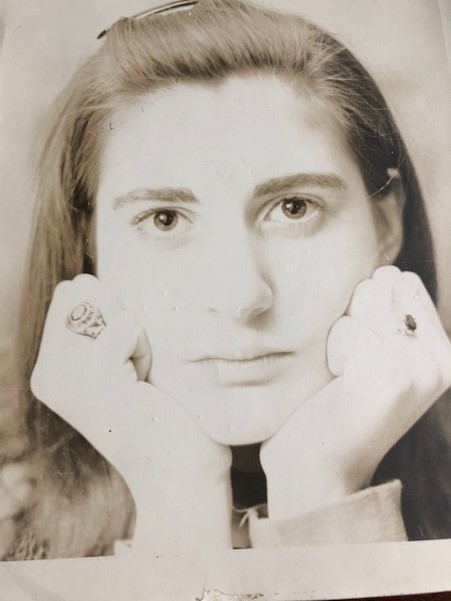
Me, at age 15. My brother took the photo, and we developed it in his home darkroom.
<
Sometimes it’s fun to write a poem based on a pattern some otherpoet used. This one is based on George Ella Lyon. She is a wonderful poet. Hereis my version. Where I am From… I am from the red house, near tothe corner of Clinton and Third. I am from two parents who lovedeach other and their children. I am from the “farm” wheresummers shaped my feelings about land, open spaces, and New England. I am from the Dutch grandparentswho cooked and baked sweet Dutch treats each Sunday. I am from those Americans whocannot gaze upon Lady Liberty with dry eyes. I am from the home with cats,laughter, and many, many books. I am from times of struggle,little money, few nice things. I am from the father who stood atour front door refusing to sign a petition to keep a Black family from buyingthe house next door, telling them to their face that they were wrong. “anybodycan buy a house if they can afford it,” he told the man. I am from the river, the brook,the bay, the sunrise on the Penobscot, the loon on the lake, thunderous waveson sharp rocks. Now, I am the mosaic of my past,one rich in places, the treasures of my travels, the friendship ties to faraway shores. All these, and especially thememories, keep my heart warm.
The house Tom and I grew up in was tall and narrow, with two regular floors and then a basement and an attic. Our bedrooms were small so the attic became our place to play as younger kids. Mom put a linoleum rug on the floor to keep us from getting splinters in our feet, hands, and knees from the wooden planks of the floor. The red flowered linoleum became Attic City.
Between the two of us, we had quite a few dolls and stuffed animals. Dolls, all girl dolls, were then married off to various stuffed animals who we made all boys. Bookshelves with the books removed were apartments for couples. We had a sort of real-sized wooden dog house that had been made in Dad’s shop at school, and this became the home of the mayor of Attic City. The mayor, named Happy, was a stuffed beagle toy with open and close eyes, and a toy Tom really liked. A small child sized table became a home for my entire family of Ginny Dolls (before Barbie was invented). I had sisters Mary and Muffy, three teen dolls named Sharon and Jill and Marian, and a baby doll named Ginette. They all had real wooden beds, with pillows and blankets. Marian was the Mom of this little family. Jill was nice. Sharon was always getting in trouble.
On rainy days, we played Attic City. We would make up stories for the characters in the town. Tom always wanted there to be a robbery or a murder. I never wanted anything bad to happen. I preferred stories with weddings, or going to school, or playing games.
On the other side of the attic, Tom had his Lionel Trains set up. Two big tables in the shape on an L, one table being the city with little houses and trees, and the other table being the country with barns, cows, and fences. The best part, in my opinion, was the train whistles. Tom had two. Sometimes we would blare both of them.
We played Attic City for years. Our last game, we had made our town its biggest yet. We thought Attic City needed lights, so we got into the boxes of Christmas ornaments. Tom strung 6 strands of lights back and forth across the attic ceiling, then did something to make them all blink, and then added the blaring train whistles.
Right about this time, probably responding to the noise, Mom came up the stairs. She was not pleased. She made us take down the lights, put them away, and clean up Attic city. That was the end of it. But then Tom was getting too old to play with a little sister anyhow. Tom still has Happy, the mayor of Attic City on a bookshelf in his home. I visit both of them at his house each year.
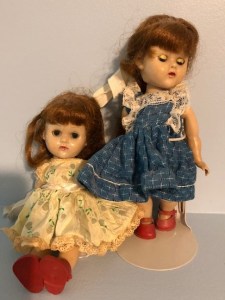
This is Mary (left) and Muffy (right) from Attic City. They are over 60 years old now, so Muffy’s eyes seem to be rusted shut. My mother made both of the dresses they are wearing.
Truly, a blessing in my life is having friends all over the world. Knowing them, and learning about their culture and traditions enriches my life. I always did love social studies!
This weekend, a family of Turks visited. The Mom had been my student. They came, the two parents and their four children and stayed the weekend. I cooked an American dinner, and they cooked a Turkish dinner. Turkish food is wonderful. Ingredients are always fresh. They use lots of tomatoes, cucumbers, onion, red lentils, potatoes, chicken and beef.
Last week I caught up some via the internet with another friend in Turkey, a friend in Lebanon, and one in Libya. Social media keeps me up to date on a friend in Indonesia, Egypt, the Philippines, Ecuador, Brazil, and Bangladesh. Almost daily, I talk on Skype with a French friend in the French territory of Guadeloupe. I practice my French, she practices her English. We have become good friends, so not our topics of conversation and deeper and more meaningful.
I certainly recommend getting to know someone from another place or culture. Don’t make any assumptions about what they are like. Just get to know each other, and see what happens!
My colleague Bill Bintz with the white hair, and two Turkish hosts at a dinner.
I don’t like this book. I don’t care that my high school English teacher thought it was one of the best books written in the English language. Bah!
My junior year English teacher, Ms. Eckstein, was a very small woman who tried to make herself taller with very high shoes and a hairdo that added 6 inches on top of her head. The day she introduced Moby Dick and forced us to begin reading it at home, on our own, I was certainly unexcited, if not dreading the experience. I was not disappointed. I found the book boring, and fell asleep several times trying to read it.
What’s more, when she introduced Moby Dick, she ranted that her famous test on Moby Dick would be very, very difficult. She admonished that no one, but no onecould pass her test if they had not thoroughly READ and DIGESTED Moby Dick (Yes, she really said that. I sat there in class picturing eating pages).
We were a good class. I liked my classmates. In the halls and at lunch, we talked about trying to read and DIGEST Moby Dick. Most of them were doing better than I was. They were muddling through, somehow. Desperate, I turned to two tools every student knows: Cliff Notes and Masterplots. Both literature tools contain summaries of books, and also pieces by literary critics. So one could read lots about the book without actually having to suffer through reading it.
I should mention that I lost respect for this teacher. Clearly she loved literature, but I never got the feeling that she liked teaching, or her students. Kids know stuff like that, right? So that once when she took me aside and said I could, with some effort, be an “A” student in her class (I was an “A” student in most classes except math), I politely told her “No, thanks. I am happy with my B.” Why? Because I did not perceive that I would gain any value, any learning, from earning her A.
Time went on and Moby Dick test day came. I was relieved when I saw it was an essay test. Yippee, I thought to myself. Because I know how to write. And I can make it sound smart and good.
That’s what happened. I wrote brilliantly. When it was the day to get tests back, Ms. Eckstein held up my paper with its A on it, and was full of sweet and sickening praise for my work, as the ONLY A in the class. Remember, I never read the book. I knew it. I looked around the room at classmates. They knew it. But, no one said a word.
I think in retrospect, we all got a little lesson out of this Moby Dick fiasco. It was not a lesson about choice, or truth, or goodness. It was about playing a game when we didn’t like the rules.
She shoved lots of books written by dead white men down our throats that year. I hated them all. I could not wait to get to summer and get a break from reading. Wow, did you hear that…a little girl who had been growing up loving books was saying she was hating reading…… Something is wrong with this picture.
THIS is why I became a reading teacher, and a professor of reading and language arts. I told new and old teachers alike, how kids need choices. Yes, they need choices in what they read. They need to find books they love. They need to find books where they see themselves in the story.
The great C.S. Lewis (author of the Narnia books) said, at least in the movie about his life (Shadowlands), “We read to know we are not alone.”
Ms. Eckstein was wrong. Her teaching was poor. I had other teachers who were great. She wasn’t one. She killed, for a time, my love of reading. NO teacher should ever do that to a student. Never.
It took me years to find my way back to books and loving reading. I still get those bad feelings Moby Dick gave me sometimes when I open a book. Every reader has the right to open a book. They have the equal right to close the book. The world is full of good books and readers can find the one – the special one – to love.
Reader choice helps to make lifelong readers. That’s our goal as teachers of reading. If we fail to make students want to read, we have not done our job.




 /
/ 


 Dr. Wendy C. Kasten, Writer